Showing posts with label Still Life. Show all posts

Monday, April 25, 2016

Ryan Parra


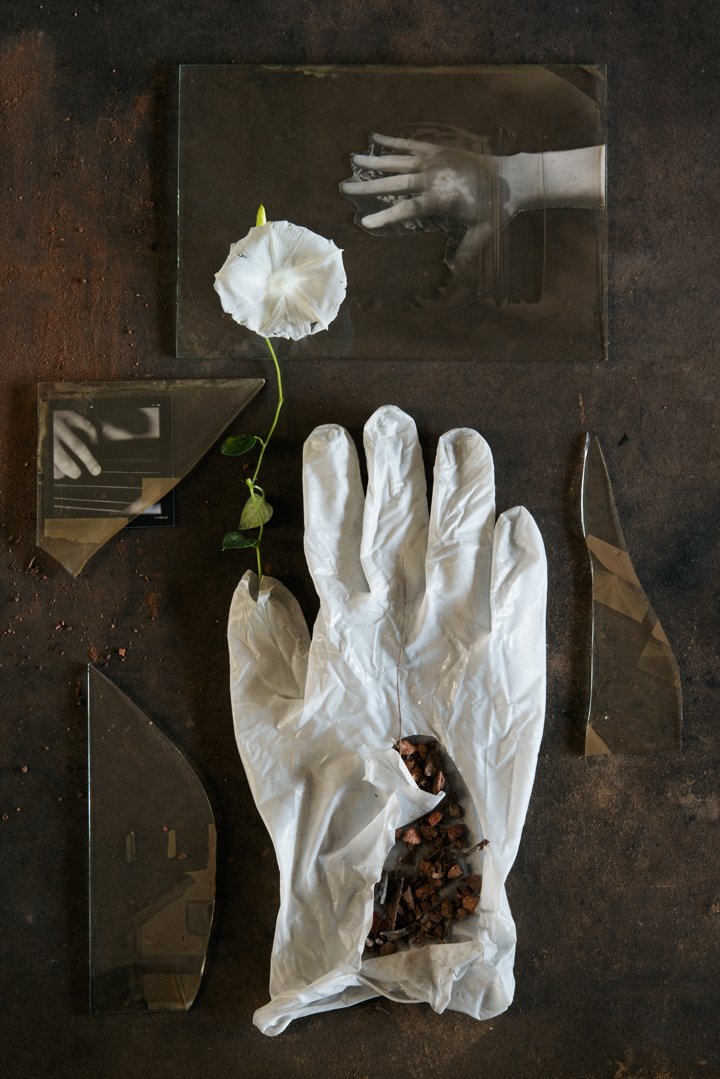
Ryan Parra is a photography based artist with a primary focus on edible, medicinal, and psychoactive plants growing in the Tempe/Phoenix valley. He earned his BFA from the University of Oregon in 2012, and MFA at Arizona State University in 2016.


Artist Statement: Vivarium

As pharmacology continues to advance, I believe it is important to have a sophisticated understanding of the plants from where it derived and knowledge of their traditional uses. My work is influenced by the rich history and current practices of ethno-botany (such as traditional shamanic practices), the history of still life paintings and plant illustrations, the exploration of plants as a system of knowledge, and the organization of agriculture for the purpose of sustaining the masses.

Urban areas continue to thrive and expand at a rapid rate, resulting in negative effects in biodiversity throughout the lands around them. As scientists are seeing a decline in biodiversity in wilderness areas, they are often finding the opposite trend in highly populated urban areas. This rise and fall of biodiversity is one of many reasons for my interest in still lifes of edible, medicinal, and psychoactive plants growing in the Tempe/Phoenix valley, as well as my focus on plants out in their natural environment. With this in mind, I hope to shed light on the rich variety and the importance of plants growing near and far from our homes. By incorporating styles from still life paintings throughout art history while also including descriptions of each plant's traditional uses, I want to remind viewers of the role plants have played in the exploration of knowledge and well being for thousands of years.

The title, Vivarium, reflects this interest in our unique relationship with nature, and sets the theme of curiosity, containment, and control. Vivarium, meaning place of life, is an enclosed space with plants or animals for observation or research purposes. For me, this act of concealing fragments of nature expresses a sense of power one has over something, much like science with nature, while also expressing great affection and love towards that same thing. It is in this binary friction that fundamental characteristics at the root of our own nature are revealed, as are issues evident in the modern perspective of the natural world.


Monday, April 18, 2016

Chris Mottalini


Chris Mottalini's photographic work has been widely commissioned and exhibited. His first book, After You Left/They Took It Apart, is an atmospheric final portrait of three demolished Modernist homes. Chris is a partially colorblind photographer that lives and works in Brooklyn, NY.


Statement: Secret Meaning 

Creative direction: Jeffrey W. Miller
Food styling: Julian Hensarling

Secret Meaning is a modern photographic interpretation of the religious and symbolic meanings embedded within 17th century still life paintings.

The project originally sprang from my fascination with Zuburon’s “Still Life with Lemons, Oranges and a Rose” (painted in 1633). The seemingly ordinary objects depicted in the painting actually contain significant religious meaning (allusions to the Holy Trinity and to the Virgin Mary). When the painting was x-rayed, several objects and layers were discovered hidden underneath. Learning of the existence of these hidden images and layers inspired me to make the photographs that comprise Secret Meaning.


In many classic still life paintings (Flemish, Spanish and Italian), fertility, wealth, death, the fall of man, the fleeting nature of earthly pleasures, decay, resurrection and vanity are all represented by such innocuous subjects as fruits and vegetables. Today, these multiple layers of meaning have become unfamiliar to us. Secret Meaning attempts to re-examine and modernize this practice.

One of the most elemental and classic “tricks” of photography, about which I have always felt a sense of wonder, is the double exposure. This technique still manages to fascinate me and is, by its very nature, indicative of the magic of the photographic process (due in part to the fact that you are always at least somewhat surprised by the final image). In using the multiple exposure technique to make many of the images in Secret Meaning, I hope to provide a new perspective on still life photography.


Monday, November 10, 2014

Brenton Hamilton


Brenton Hamilton is a artist working in Maine and leading courses at Maine Media Workshops where he has taught for over two decades. Brenton is a photography historian and a practicing artist in several media. He was educated at Savannah College of Art and Design, MFA 1992.

Hamilton has led classes at Maine Media Workshops for 22 years and his specialty areas include the history of photography, B&W darkroom craft and the historic processes. Brenton lectures widely both in Maine and nationally about contemporary issues in photography, its history and other subject area interests within the medium and contemporary trends. He is also on the adjunct faculty at The Center of Alternative Processes in New York City. Brenton is a contributing writer and president of Obscura, founded in 2009, a non profit organization devoted to the progress of youth education in photography and books.

His work is represented at TILT Gallery in Scottsdale, Arizona and in Maine at Susan Maasch Fine Art. Hamilton’s photographs are held in permanent collections at the Farnsworth Museum of Art, Portland Museum of Art, University of New England Permanent Collection and many significant private collections nationally. His first monograph was published by Obscura Press in 2010: The Blue Poet Dreams.

Statement 

Drawn to concepts of time and invention - Brenton builds small meta worlds to contemplate and experience. Via still life and collage; intimate spaces where time is suspended and rearranged is the manner in which Hamilton re jiggers the world and makes a private space for his viewers. Employing often the strange deep blue depth of the cyanotype or recently the odd spectrum of collodion on black glass. Hamilton's new and old worlds collide inviting the viewer to new possibilities.


Ashley Kauschinger: Let’s begin by having you tell us a bit about yourself, and your passions.

Brenton Hamilton: I am a Maine artist and now live and work here - I also grew up here spending alot of my early boyhood on an island with my parents. Which was influential - and a particular way to grow up. Without phones, electricity only for certain times of the day, we had rythems of movement - we didn't have a car for a long time for example. The horizon - which any island person would agree is a destination, everything was always: "over there". So, the horizon line was something that I looked at in early work that I did with the large camera in Georgia.

My own interests are a deep study of history which is a large influence upon my work so I may be drawn to books and archives - o.k. full disclosure I am !! American and European cultural history and of course art & photography have great stories that sustain me.......I have a large collection of primarily 18th C. Spanish antiques and I photograph the objects among other things. I find the objects magical and full of animation and and mysterious gesture. Many of those images are here in our interview. The antiques and my creative work merge. Fencing is also a passion - that's sword work. I fence foil & sabre. Ive studied the history of the practice of dueling with some depth.


How does a body of work come together for you, from start to finish?

The research that I do about culture and the objects that I'm drawn to have a wonderful rapport together. I get ideas from the research - I want to respond and invent that atmosphere. So, via collage and cyanotype or lately still life practice and these small set ups that I build, I make these things for the camera. Its a fantasy of course, an invention. I build something - and photograph it.

What environment do you create for yourself in your studio?

The rooms that I work in are a ramshackle tumble of books and papers, notes with ideas and things that I want to remember and also light. The room has great light. The objects are on pedestals, stacks of carpets and lean against one another. Creating moments of chance and interesting configurations. I also know that I don't work constantly. Things build up and then I have to make them and do my camera practice and printmaking.


How do you think about marrying form and content in your work?

I have always been drawn to the expressive potential of the 19th C historic processes - because of patina (paper surface) and the physical work involved in the making of the images. The black glass ambrotytpes and the collodion process has the physicality to it that I enjoy and feel "involved" in when doing it. The black ground of glass support is for the image to rise out of and is also exhilarating. That's actually similar to my years with cyanotype - a deep blue ground was a 'space' for my story to be told - and the image or figure would rise out of the deep color......it still gets me every time.


Who are your Photo Heroes?

Oh, that's a tough one for a historian, Ashley......Wm. Talbot and the French calotypists, Anna Atkins - But I also respond to and admire so much contemporary work right now such as Alison Rossiter, Matthew Brandt and especially Mariah Robertson. The materiality of photographs - and things that are light sensitive.

How does participating in sharing your knowledge through teaching contribute to your work? 

I love the classroom - its dynamic and its often challenging. Its a huge influence - and I get to talk about others work but its reciprocal because were doing the same thing/the same mission. That is: moving work and ideas forward.

Do you feel it inspires you? 

It really does......


Tell us about your participation with Obscura, a non-profit organization that
supports the arts and arts education through publishing, scholarships, and grants.


This is a great small org. - with a terrific mission. To assist youth with creative experiences in the medium, to publish good work in book form or in essay form on our web site. So, we work on raising funds via book sales and direct reach, give scholarships or materials support.

What initiatives are you working on? What is the best way for the photo community to help?

Our aim this year is another student scholarship for a short workshop experience in photography. It is a non profit - so we need to build the treasury to help these kids out. So, get in touch, donate if you can - everything matters even a little. The book purchases go directly to the work we do. But we also love good work and like to publish serious essays on the medium on our site. We published "Black Apple" by Thatcher Cook a while back and its doing well. We are all very proud of the book and our work.

How do you find balance between your artist practice, teaching and being the
president of Obscura?

Good question - its all the same though - participating in photography in a myriad of ways gets me to work everyday ! Helping young students, sustaining my own art practice and gallery work and the energy of the classroom all make a difference in my life.


Monday, February 10, 2014

Jaclyn Wright


Jaclyn Wright was born in 1986 in Peoria, IL. She received a Bachelor’s in Art from Southern Illinois University Carbondale in Cinema & Photography in 2009. She went on to get her Master’s of Fine Art in Photography at Indiana University in 2013. She has also studied at the Hospitalfield House Art Centre in Arboath, Scotland and at Kyoto University of Art & Design in Kyoto, Japan. She was the 2013 recipient of the Master’s of Fine Art Grant from Indiana University. Her work has been shown both nationally and internationally and has been selected for several Internet galleries and blogs. She is currently the Visiting Artist in Residence at the University of Cincinnati.

View more of Jaclyn's work here 


In Japanese culture, the landscape is often surrounded by elaborate protective structures, made from cloth, straw and wooden beams. These designs are thoughtfully and meticulously put in place. Trees are often wrapped in komomaki, a traditional straw wrapping meant to keep out pests, or found under the umbrella of a yukitsuri, to keep heavy snow from breaking their branches. The desire to carefully control and preserve the landscape is significant to the Japanese aesthetic. This way of thinking, brought up the ways in which different cultures, and individuals, place significance on particular objects and philosophies. Much like an archeologist, I began to collect and catalog my own artifacts as a means for preservation. By approaching personal subject matter through a systematic perspective, I’ve been able to decontextualize and deconstruct the significance of each piece. The images are a reference to an anthropological perspective, so that they may, in some sense, become didactic regarding cultural and social practices. Through still life’s, the images mimic the way in which archival information is photographed, so that the subject may accurately represent “reality”.


Friday, March 22, 2013

Photo Friday: Ellen Cantor


Ellen Cantor was born in Chicago, and lives in Southern California. Her work has been exhibited at the Platt/Borstein Gallery at American Jewish University in Los Angeles, in L’aura borealis at the Palos Verdes Art Center, Bryn Mawr Rehab Hospital Art Ability Exhibition in Malvern, PA, C.A.R. Network, The Innovative Art Fair in Seoul, Korea, WUHO Gallery and the Los Angeles Art Association/Gallery 825.

View more of her work here  


Unorthodox Anatomy Statement 


Approximately two years ago, I descended into spinal purgatory, unable to walk or stand for very long. Suffering with unrelenting leg and hip pain, I tried exercise, meditation, physical therapy and acupuncture. Having been diagnosed with scoliosis, spondylolisthesis and stenosis, I started to visualize the anatomy of my lumbar spine and what it meant to be out of alignment. I imagined the spine’s complex network of bones, muscles, nerves and discs and how they could be causing me so much discomfort.

Using sculpture and photography as a means of expressing my pain, I created artworks that reflect my desire to understand what was happening to my vertebrae and how surgery might change the structure of my spine.


This series of photographs, from sculptures I have created, focuses on my perception of pain and the spine and how pain can impact mortality and my perception of aging. Based on my medical diagnoses, I perceived my body and my vertebrae as both organic and inorganic materials with the spine out of shape, constricted, disintegrating or collapsing.

As my daily options became diminished, I began to feel constricted. Navigating the world with new restrictions, I needed to deal with multiple medications, wired instruments to control pain and the need for a constant supply of batteries to keep the machines working. With my activities restricted, I started to see myself confined to a narrower world. Filling the cage with my necessities, became a way of visualizing how I was feeling.

Through allusion and metaphor, I am addressing images of pain sensations and options for living. For this series, I have created a visualization of what my spine looks like to me--not the real spine, but an unorthodox view of my anatomy. These photographs convey my feelings of living with a disability, the pain of aging and daily confrontation with my mortality.


Monday, October 1, 2012

Sandra Elkind


Sandra Elkind received her MFA in photography from Parsons in 2010, and her work has been exhibited nationally. She describes herself as a "visual artist and memory collector".

Learn more about Sandra here: http://sandraelkind.com/


Ashley Kauschinger: Flat Pennies & Other Tales forms a connection between memory and fables. What are your thoughts on how memories evolve into fables and how that is integrated into your work? 

Sandra Elkind:  I believe that memories evolve into fables because they are intangible and personal.   While being created they are filtered through emotions and because of their lack of form they are inherently fluid.  Over time the line between fact and fiction becomes even more blurred leaving the mind to fill in for the missing information.  

In Flat Pennies & Other Tales (FP&OT) I am specifically working from memories of events that were not captured by a camera. But, I believe that all types of memories, even those associated with images, are vulnerable.  A good example would be when a memory holder relies on an image that was created by anyone other than the memory holder.    If the photograph was edited and composed from another person’s point of view that will eventually affect the memory of the event.     

In order to create a physical representation of this evolution in FP&OT, my sets are built with a mixture of both two-dimensional and three-dimensional objects.  While building, I am using a verbal recalling of the event as a reference.   I find that sometimes I am guided more by the way a person recalls the event then the story itself.  The more dramatic they are, the more dramatic the lighting and color palette become in the set.  The final product is created when I photograph the set flattening all the layers into one.   


AK: How do you collect the memories your photographs are based off of and then go about interpreting them? (I believe you use others memories and not your own?)

SE: Over the years I have found that strangers feel comfortable opening up to me and sharing with me personal stories.  Because I have spent a fair amount of time on the road for past projects I have had the opportunity to meet many fascinating people.  In 2009 I had a particularly moving conversation with a gentleman on a train from New York to Washington D.C and at that time I decided to start collecting these stories.  I now keep with me at all times a little kit with tools that will help me document these spontaneous conversations.  Since starting this practice I have been commissioned to reconstruct past moments for clients and I have also worked with memories of my own. 

My interpretation process has some similarities to a set designer’s process for theater.  After studding the story and analyzing the key points I create sketches of my ideas and build mockups from those sketches.  The final sets I build are large enough for me to physical engage with them while they are being photographed and because of this in the final image you only see about 50% of the original set.


AK: Your sets are beautifully constructed, how long does each set take you to build, do you collect the objects over time, and how to you combine elements like the miniatures and a photograph or a projection? 

SE: Thank you. Each set is very different because the stories I work with are based on such different themes. I have two in my studio right now that I have been working on for six months because I am having difficulties creating the desired aesthetic.  But I have also had sets that are done in two weeks. 

I have no idea in advance what the stories will require and some of the props are custom made.  When it comes to combining the projections and photographs with the sets I have a lot of freedom. My sets are more like maquettes; they are not permanent and are never on display. This gives me the ability to use any means necessary to install inside the set and not worry about wires or preservation.    


AK: What is your process of self-promotion? How do you make a balance between making work and promoting it?

SE: I am an emerging artist and so self-promotion takes a lot of my time.  I spend the majority of this doing research.  To see if the people I reach out to, the competitions I enter, the portfolio reviews I attend or the groups I work with are right for my work.  There are some key events that are helpful for emerging artist.  Attending fairs like Art Basel give you a chance to see in person galleries from around the world and the work they represent.  For photographers, attending the more established portfolio reviews, like Houston, give you a chance to be face to face with some of the most important gallerists, editors, collectors and critics in the world.  That type of access is worth every penny you spend to attend. 

I am only able to strike a balance between making work and promoting it because of my desire to create.  If you do not have this desire then you have no new work to promote. 


Thank you, Sandra for sharing your thoughts!