Showing posts with label Cyanotype. Show all posts

Monday, February 8, 2016

Heather Wetzel


Heather F. Wetzel is an artist working in historic photographic processes, hand papermaking, and book arts. She is currently a Lecturer in the Art Department at The Ohio State University where she was the 2011-2012 Post MFA Fergus Family Fellow in Photography. She earned her Master of Arts & Humanities from Arcadia University in Glenside, Pennsylvania, and her Master of Fine Arts in Visual Studies from the Visual Studies Workshop in Rochester, New York. Prior to coming to The Ohio State University, she completed the University of Iowa Center for the Book Graduate Certificate in Book Arts Technologies in 2011. She is a 2012 Photolucida Critical Mass Finalist, as well as a semifinalist and The Print Center's Honorary Council Award of Excellence winner in The Print Center's 87th International Competition. More recently, she was a Review Santa Fe participant. Her work has been widely exhibited, and can be found at the Anzenberger Gallery in Vienna Austria, as well as in multiple collections.


Superstitions   

Artist Statement 

Time moves so fast. It seems there is less and less time for the slower things in life. Time to sit and reflect, time to remember, time to notice the little things. Analog ways are being replaced by faster technology. Photographic prints and books are being replaced by intangible, transient digital files made of zeros and ones - no texture, no smell, no weight. I prefer to work at a slower pace, with materials and process playing important roles in my making. My work is grounded in contemplation of life in the 21st Century, examining current social concerns, using a variety of materials and methods.

Squall


The quest for the best form for my ideas to inhabit finds me working in a variety of media, such as historic photographic processes, book structure and content, print, hand paper making, metal, and wood. I am equally concerned with the object and alternative methods of display, and with how my chosen materials support concept and content. I work predominantly with analogue processes, but am also interested in how these methods complement digital technologies, and work to seamlessly integrate digital processes as concepts dictate. My interest in these processes and materials all contribute to my concern in multi-media constructions and art as object.

Impractical Library 

Impractical Library 

Impractical Library 

Webster's New 20th Century 

Webster's New 20th Century 


Impractical Leisure 

Impractical Leisure 

Impractical Leisure 

Impractical Leisure 


Monday, August 24, 2015

How to: Make a UV Exposure Unit for Alternative Processes


In this tutorial, Ashley Whitt and Ross Faircloth, share their experience creating an at-home UV exposure unit. If you live in a location that seldom sees sunlight, or would like to work on alt process any time of the day and night without buying an expensive pre-made unit, continue reading!


Items needed 

all can be purchased from Home Depot or Lowes

   Screwdriver (flat head)
   Wire Strippers
   Electrical tape
   48” Light Fixture (2)
   48” UV Bulbs (4)
   Fabric (Opaque) 
   Electrical wire, cut to length (2) 

Wire type: Carol 3/C 14 AWG SJOOW 300volt (the exact wire brand is unknown, your local hardware store should have this wire on a large rack to buy per foot, an associate will cut it down to size for you.  Just let them know you need standard wire (w/ ground wire inside) for a fluorescent light fixture)

   Electrical plug – three prong (2)
   Wire nuts (6)any size will work


1. Buy two Fluorescent light fixtures (48”) at your local hardware store. If you buy them and they are not pre-wired you will probably save a little money but add an extra step later in the process. 


 2. You will also need to buy 4 UV bulbs, at 48”. If you chose a light fixture without pre-existing wires, you need to also pick up two lengths of Electrical cable and two 120v plugs. 


3. We installed our light fixtures into a pre-existing set of storage shelves. This saved time because we did not have to create a wooden box or structure to house the light fixtures.  Storage Shelves: http://www.walmart.com/ip/Edsal-48-W-x-24-D-x-72-H-5-Shelf-Steel-Shelving-Black/21685762

4. When you get the lighting fixtures home, find the instructions inside the box. These provide a general outline of the way the wires run in the lighting fixture. Be careful of the sharp metal edges.

 5. After setting up the lighting fixture properly, you are now ready to attach the electrical cord you had cut to length to the wires in the lighting fixture.  You should see a power box inside the lighting fixture that has two wires (black and white) coming out of it.  There is also a green painted screw about mid-way down inside the light fixture, this is for your ground wire (green wire).  You will unscrew this just enough to fit the exposed copper around the threads of the screw then tighten it back down. 

6. Use the wire strippers or a utility knife to strip back 2-3” of the main cord. This will expose the black, white and green wires inside.  Now strip back about ½-1” of each wire (white, black, and green), that you just exposed from inside the main chord.

7. Use your wire nuts to attach the now exposed copper from the black and white wires to each corresponding wire (black to black, white to white).  After this is complete, the lighting fixture is ready to be closed up.  Electrical tape can be used to hold the cover tight, mine liked to slip and hit the bulbs every now and then. 

8. Move on to the other end of your electrical wire and strip back enough to allow you to connect each wire to the correct screws inside your 3-prong plug.  The amount to strip back can be tricky as it is a tight fit for all 3 wires so err on the side of to little, as you can always strip back more as needed.


9. Inside the 3-Prong plug you will see a gold screw, silver screw and green screw.  The gold screw will connect to the black wire, the silver to white and green to green. When you finish tightening all the screws down and close up the plug your U.V. box is ready for the UV bulbs.

10. The UV bulbs will slide into the grooves and twist counter-clockwise to set in place. Once both bulbs have been put in the lighting fixture is ready to be plugged in.


11. Hanging the lights is next and may vary depending on your placement. The simplest hanging method is metal hangers with a chain. These will either come with the lighting fixture or will be sold right next to them.  

Complete exposure unit (uncovered)

Complete exposure unit (covered)

12. Once everything is hung, the next stop is keeping as much UV light contained as possible.  We taped thin paper boards on the left and right sides of the shelf (like you find on the back of sketchpads or legal pads). You can use anything here that fits the space (approx.. 18-24” x 18-24”, depending on size of shelving unit).  Then use an opaque fabric to cover the long sides (48”), it should be large enough that it covers front and back down to the printing surface (approx.. 42”). 

Cover lifted to show cyanotype exposing 

13. To create an exposure, place a contact frame containing your image HERE and turn the exposure unit on. Set an alarm on your phone for the exposure time, and when it beeps turn the unit off. 


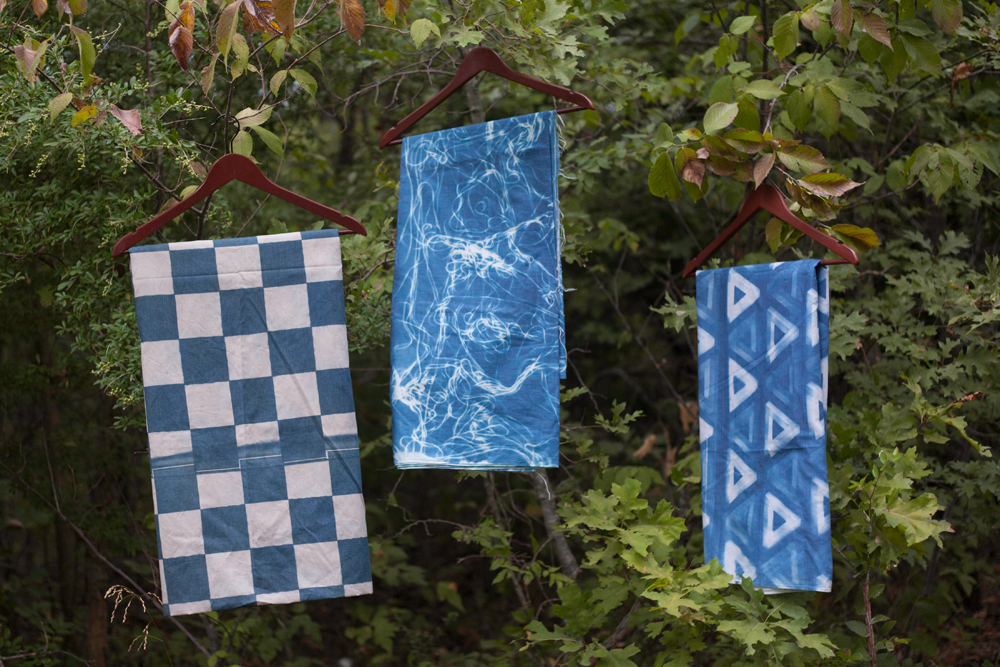
 Garments by Kristen Whitt. For inquiries about fabric and/or garments, please email: whittandwhittfabric@gmail.com


P.S- the winner of the giveaway will be announced tomorrow


Monday, March 2, 2015

Lindsey Beal


Lindsey Beal is a photo-based artist in Providence, Rhode Island where she teaches at Rhode Island College. She has an M.F.A. in Photography from the University of Iowa and a Certificate in Book Arts at the University of Iowa’s Center for the Book. She is represented by Boston's Panopticon Gallery.

Her work combines historical & contemporary women’s lives and feminism with historical photographic processes. She is interested in the photograph as object and often includes sculpture, papermaking and artist books into her work.

Her work has been shown at national museums, galleries and universities and is included in various public & private collections. She recently earned an Honorable Mention for Center Forward 2014 at the Center for Fine Art Photography. She was a Finalist at the 87th Annual International Print Competition at The Print Center and received an Honorable Mention for emerging American photographers by the Magenta Foundation. Her work can be found at lindseybeal.net.


Artist Statement: Transmission

A bacterial sexually transmitted infection is a living, growing, mutating thing that exists within the human body. The act of transmission is often sexy; yet what is transmitted is menacing. The bacterial STIs before you (BV, Chlamydia, Trichomonas, Gonorrhea and Syphilis) can be silent for women and have little to no symptoms for men: they reveal themselves mainly through medical tests. Without testing, the cycle continues: without noticeable symptoms, no treatments are received; without treatments, the infections are unknowingly passed to others. Though mostly silent, all of these infections have potentially catastrophic side effects like pelvic inflammatory disease, joint disease, meningitis, sterility and fatal pregnancies. Although we should have eradicated these long ago, bacterial STIs continue to exist. Frighteningly, they are beginning to mutate and become drug resistant; gonorrhea specifically has outgrown our current treatments. Due to the recession, many non-profit clinics in which these STIs could be identified and treated have closed. What once seemed like a scary yet treatable nuisance or temporary problem is becoming a major public-health concern.

Transmission’s images are created by using open-source imagery from the Center for Disease Control. The images were altered, and then converted into digital negatives, which were used to print the cyanotypes. The prints are embedded in resin within Petri dishes. Each STI is represented in various images and whose information and prevention can be read about in the accompanying artist book.


Monday, November 24, 2014

Jaime Johnson


Jaime Johnson grew up in Mississippi where the sounds of wild animals outside her window became her daily melody. Jaime received her BFA from the University of Mississippi in Imaging Arts and her MFA in Photography from Louisiana Tech University. Johnson was named a finalist for the 2014 Clarence John Laughlin award and her work has been shown nationally. Her series Untamed recently won the Grand Prize in the Maine Media Workshops international contest Character: Portraits and Stories that Reveal the Human Condition.


Untamed chronicles the intimate relationship of a feral woman and her surrounding natural environment. She collects the bones, branches, and flora of her world and treads with the animals, both dead and living. The cyanotype process shifts focus from potentially colorful landscapes and figures to patterns, textures, and the relationships of forms within the images. Discovery—both psychological and physical— is present and reveals each of us, whether human or animal, is a part of a shared experience. Untamed ultimately reflects upon the forms, the impermanence, and the interconnectedness of nature’s life.


Monday, November 10, 2014

Brenton Hamilton


Brenton Hamilton is a artist working in Maine and leading courses at Maine Media Workshops where he has taught for over two decades. Brenton is a photography historian and a practicing artist in several media. He was educated at Savannah College of Art and Design, MFA 1992.

Hamilton has led classes at Maine Media Workshops for 22 years and his specialty areas include the history of photography, B&W darkroom craft and the historic processes. Brenton lectures widely both in Maine and nationally about contemporary issues in photography, its history and other subject area interests within the medium and contemporary trends. He is also on the adjunct faculty at The Center of Alternative Processes in New York City. Brenton is a contributing writer and president of Obscura, founded in 2009, a non profit organization devoted to the progress of youth education in photography and books.

His work is represented at TILT Gallery in Scottsdale, Arizona and in Maine at Susan Maasch Fine Art. Hamilton’s photographs are held in permanent collections at the Farnsworth Museum of Art, Portland Museum of Art, University of New England Permanent Collection and many significant private collections nationally. His first monograph was published by Obscura Press in 2010: The Blue Poet Dreams.

Statement 

Drawn to concepts of time and invention - Brenton builds small meta worlds to contemplate and experience. Via still life and collage; intimate spaces where time is suspended and rearranged is the manner in which Hamilton re jiggers the world and makes a private space for his viewers. Employing often the strange deep blue depth of the cyanotype or recently the odd spectrum of collodion on black glass. Hamilton's new and old worlds collide inviting the viewer to new possibilities.


Ashley Kauschinger: Let’s begin by having you tell us a bit about yourself, and your passions.

Brenton Hamilton: I am a Maine artist and now live and work here - I also grew up here spending alot of my early boyhood on an island with my parents. Which was influential - and a particular way to grow up. Without phones, electricity only for certain times of the day, we had rythems of movement - we didn't have a car for a long time for example. The horizon - which any island person would agree is a destination, everything was always: "over there". So, the horizon line was something that I looked at in early work that I did with the large camera in Georgia.

My own interests are a deep study of history which is a large influence upon my work so I may be drawn to books and archives - o.k. full disclosure I am !! American and European cultural history and of course art & photography have great stories that sustain me.......I have a large collection of primarily 18th C. Spanish antiques and I photograph the objects among other things. I find the objects magical and full of animation and and mysterious gesture. Many of those images are here in our interview. The antiques and my creative work merge. Fencing is also a passion - that's sword work. I fence foil & sabre. Ive studied the history of the practice of dueling with some depth.


How does a body of work come together for you, from start to finish?

The research that I do about culture and the objects that I'm drawn to have a wonderful rapport together. I get ideas from the research - I want to respond and invent that atmosphere. So, via collage and cyanotype or lately still life practice and these small set ups that I build, I make these things for the camera. Its a fantasy of course, an invention. I build something - and photograph it.

What environment do you create for yourself in your studio?

The rooms that I work in are a ramshackle tumble of books and papers, notes with ideas and things that I want to remember and also light. The room has great light. The objects are on pedestals, stacks of carpets and lean against one another. Creating moments of chance and interesting configurations. I also know that I don't work constantly. Things build up and then I have to make them and do my camera practice and printmaking.


How do you think about marrying form and content in your work?

I have always been drawn to the expressive potential of the 19th C historic processes - because of patina (paper surface) and the physical work involved in the making of the images. The black glass ambrotytpes and the collodion process has the physicality to it that I enjoy and feel "involved" in when doing it. The black ground of glass support is for the image to rise out of and is also exhilarating. That's actually similar to my years with cyanotype - a deep blue ground was a 'space' for my story to be told - and the image or figure would rise out of the deep color......it still gets me every time.


Who are your Photo Heroes?

Oh, that's a tough one for a historian, Ashley......Wm. Talbot and the French calotypists, Anna Atkins - But I also respond to and admire so much contemporary work right now such as Alison Rossiter, Matthew Brandt and especially Mariah Robertson. The materiality of photographs - and things that are light sensitive.

How does participating in sharing your knowledge through teaching contribute to your work? 

I love the classroom - its dynamic and its often challenging. Its a huge influence - and I get to talk about others work but its reciprocal because were doing the same thing/the same mission. That is: moving work and ideas forward.

Do you feel it inspires you? 

It really does......


Tell us about your participation with Obscura, a non-profit organization that
supports the arts and arts education through publishing, scholarships, and grants.


This is a great small org. - with a terrific mission. To assist youth with creative experiences in the medium, to publish good work in book form or in essay form on our web site. So, we work on raising funds via book sales and direct reach, give scholarships or materials support.

What initiatives are you working on? What is the best way for the photo community to help?

Our aim this year is another student scholarship for a short workshop experience in photography. It is a non profit - so we need to build the treasury to help these kids out. So, get in touch, donate if you can - everything matters even a little. The book purchases go directly to the work we do. But we also love good work and like to publish serious essays on the medium on our site. We published "Black Apple" by Thatcher Cook a while back and its doing well. We are all very proud of the book and our work.

How do you find balance between your artist practice, teaching and being the
president of Obscura?

Good question - its all the same though - participating in photography in a myriad of ways gets me to work everyday ! Helping young students, sustaining my own art practice and gallery work and the energy of the classroom all make a difference in my life.