Showing posts with label Louisiana Tech. Show all posts

Monday, April 20, 2015

Zachary McCauley

from the series Sometimes This Can Be Difficult 


Zachary McCauley's work primarily explores ideas of identity, family, ritual, and interpretation through photography, video, audio, and performance. He received his BFA in Studio Art with a concentration in photography from Jacksonville State University in 2011. His work has been exhibited across the nationally and published in national magazines such as Aint-Bad Magazine and PDNedu. Most recently Zachary was honored to receive the grand prize in the Fine Art/Personal Work category in the 12th annual PDNedu Student Photography Competition. Zachary lives in Ruston, LA with his wife Hannah Cooper McCauley, also a photographer. Both are pursuing an MFA in Photography at Louisiana Tech University.


Artist Statement for still images: Sometimes This Can Be Difficult

Growing up in the American South, I have always been surrounded by a notion that the region is one of magic, pride, family unity, and rich history. My own experiences with the region have been less than this ideal. The poverty of my youth and an immersion in drug culture during my late teens and early twenties have granted me access to a side of the South that is not often praised - one where magic is replaced by hot languor, beauty is found in squalid homes and damp alleys, and litter becomes a landmark to the unseen and the forgotten.

I find that the often overlooked or banal moments in everyday life are what connect the various segments of the South as a culture and as a region. While each partition of the landscape is home to local customs, it is the ever present, everyday nothing of the background that ties people and the region together.

This collection of images represents the camaraderie and love that I share with displaced or forgotten spaces, moments, and objects found during my recent period of uprootedness within the South from one state, both geographically and emotionally, to another. I hope to find hints of who I am as an individual, as well as within Southern culture through these explorations, but sometimes this can be difficult.


  Video Piece, "NONE SHALL MOVE WITHOUT THE OTHER" from Zachary McCauley on Vimeo.


  Video Piece, "Repeater" from Zachary McCauley on Vimeo.


Monday, January 5, 2015

Joli Livaudais


Anima (detail), eighteen 16" x 16" panels, total size of 96" x 48"
Aluminum, resin, and inkjet photographic print on Kozo paper


Joli Livaudais received her BA and MS in Experimental Psychology from the University of Texas at Arlington before establishing herself as a freelance commercial photographer in Dallas, Texas. Livaudais received her MFA from Louisiana Tech University in 2013, and is currently an Assistant Professor at The University of Arkansas at Little Rock. Her fine art incorporates her interest in psychology and explores the relationships between people and the constructs we use to interpret the world around us, and has been exhibited nationwide.

Animus (detail), eighteen 16" x 16" panels, total size of 96" x 48"
Aluminum, resin, and inkjet photographic print on Kozo paper


Artist Statement: Dreams and Replies

My artwork is an expression of my search for insight. The photographic compositions are inspired by my unconscious mind, through journaled dreams and free writing. They are my meditations on a universe and existence that is exquisitely beautiful, perfectly synchronized, and uncompromisingly merciless. I find that my carefully weighed conclusions about the human condition challenge me more than they provide any meaningful sense of safety, comfort, or promise of a happy ending. To exist is to struggle. In my artwork, this translates as an attention to process and labor-intensive practice. The accumulation of layers, fragmentation, deterioration, and replication are natural processes that are integral to the work and the meditation of creating it. Although the nature of the work lends it a timeless quality, I choose to use contemporary and experimentally combined materials including resin, photographic ink jet prints, aluminum foil and electrical circuits. The concepts I am exploring are primal, but my interpretation and understanding of them is anchored in today.

Observing Jonathan (1), 24" x 24" x 7"
Plexiglass, resin, photographic prints on film, and electrical wiring with lighting


Tarot XXI, 36"x36"
Gum Bichromate photographic print on brass plate

The Womb, 30" x 30" x 3"
Epoxy resin and inkjet photographs on kozo paper
The Womb (detail)
Core Sample, 14" long, 3" diameter
Resin, gold leaf, charcoal, bird skill, dye, photographic prints on kobo paper
All That I Love is comprised of over 1600 origami beetles (Installation below)
Aluminum, resin, and photographic prints on kozo paper

The Mother, Exhumed, 42"x16"x12"
Epoxy resin and inject photographs on kobo paper

The Mother, Exhumed (detail)

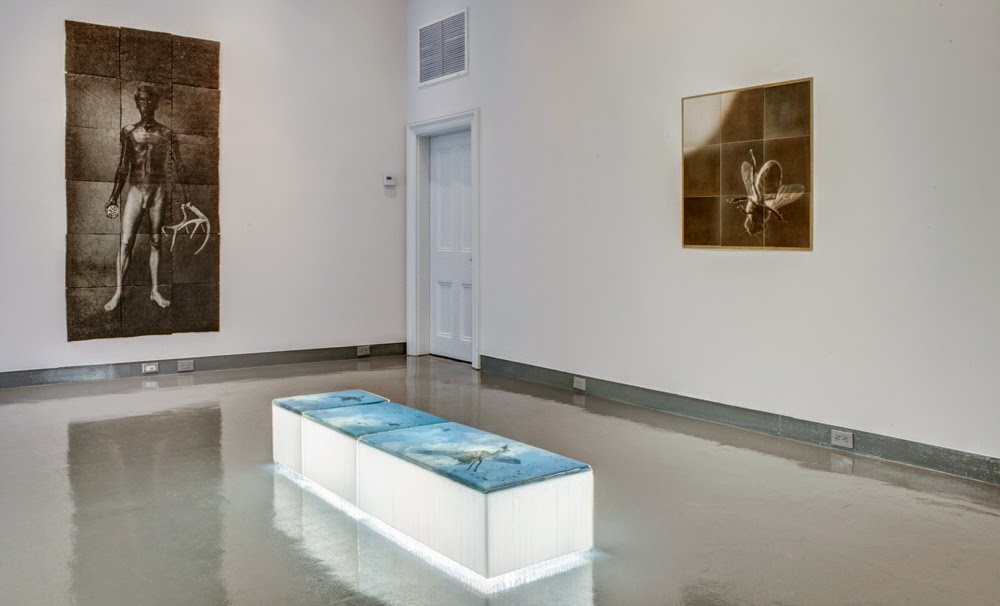
Installation view of Dreams and Replies, Martine Chaisson Gallery, New Orleans, LA

Installation view (2) of Dreams and Replies, Martine Chaisson Gallery, New Orleans, LA
Installation view (3) of Dreams and Replies, Martine Chaisson Gallery, New Orleans, LA


Monday, November 24, 2014

Jaime Johnson


Jaime Johnson grew up in Mississippi where the sounds of wild animals outside her window became her daily melody. Jaime received her BFA from the University of Mississippi in Imaging Arts and her MFA in Photography from Louisiana Tech University. Johnson was named a finalist for the 2014 Clarence John Laughlin award and her work has been shown nationally. Her series Untamed recently won the Grand Prize in the Maine Media Workshops international contest Character: Portraits and Stories that Reveal the Human Condition.


Untamed chronicles the intimate relationship of a feral woman and her surrounding natural environment. She collects the bones, branches, and flora of her world and treads with the animals, both dead and living. The cyanotype process shifts focus from potentially colorful landscapes and figures to patterns, textures, and the relationships of forms within the images. Discovery—both psychological and physical— is present and reveals each of us, whether human or animal, is a part of a shared experience. Untamed ultimately reflects upon the forms, the impermanence, and the interconnectedness of nature’s life.


Monday, October 6, 2014

Frank Hamrick


 I have been an admirer of Frank Hamrick's photography and book arts for some time, and was inspired when I saw his work in person at the exhibition, Pathways, that just closed at the McMaster Gallery at the University of South Carolina. Below find a few insights Frank shared about his work and process.

Frank Hamrick is an associate professor at Louisiana Tech University. His work mixes photography, storytelling, handmade books and found objects. Frank received his BFA from The University of Georgia and his MFA from New Mexico State University. NPR has written about Frank’s handmade books and in 2012 Oxford American Magazine listed Frank as one of the 100 Superstars of Southern Art. His work is housed in collections including the Georgia Museum of Art and The Ogden Museum of Southern Art in New Orleans.


Ashley Kauschinger: What role does the personal play in your work?

Frank Hamrick:
I have made satisfying work of strangers and places I’ve visited, but most of my work is tied to my connection to places I have lived and people who are close to me. Photographer Christine Shank once said the most personal work is the most universal. I find that to be true as long as the work leaves an entry point for viewers to relate to the content.


AK: How did you get involved with alternative processes, and what are your thoughts about its uses in contemporary photography?

FH:
Digital photography has made things more accessible to people but also leaves many feeling removed from the process. These hands on, alternative methods being practiced can be seen as a reaction to the proliferation of digital processes, but there are also a lot of analog/digital hybrid processes being developed.

My bookmaking is a good example of blending analog and digital methods.

A few years ago one of my graduate students had been unsuccessfully trying to learn how to make tintypes. I did not know how to guide him. My solution was to start learning the process over winter break and then return to school and show him.

I usually challenge myself with learning something new each year, whether it is how to expose an image onto a leaf using its chlorophyll or how to create and document a camera obscura. Then I share that information to my students and peers.


AK: You are an accomplished book artist. Do your books inform your photographic work? Or do they communicate what can’t be said through photography alone?

FH:
People like my images on the wall but my photographs tend to resonate better with viewers when they are sequenced and presented as books, something the viewer can hold and turn its pages, rather than standing across the room looking at it on the wall in a “do not touch” situation.

If you were to think of a photograph in the same way you consider a single song, then an artists’ book is similar to an entire album of music complete with cover art and liner notes. The artists’ book allows me to combine imagery and text and incorporate materials, like handmade paper, and processes, such as staining and letterpress printing, to create unique or limited works of art.


AK: What is your editing process? How does it differ when you are sequencing a book vs. an exhibition?

FH:
When making a book I prefer to choose a photographic series that I feel is finished or at least there is a completed chapter in the series. I do not want to create a photography book of new work and then a week later make a new photograph that I wish was in that book. I spend a fair amount of time thinking about the possible connections that can be made between the images on the left and right spreads in the book. I also consider the overall arch of the story the images convey in the book. My books tend to have a small selection of images. Past books have ranged between 6 – 24 images depending on the project. It is not unusual for good images to be left out of a book because it did not fit in the sequence and story told by that particular book.

Exhibitions tend to be more open. I do think about the sequence in a show like I do in a book. But I take more risks, often showing new images or ones I am curious to see how people respond. Often my exhibitions include photographs that do not make their way into my books because over time they are replaced by new, stronger images.


AK: You are also an Associate Professor at Louisiana Tech University. How do you find balance between teaching, your artist practice, and life?

FH:
It is challenging to balance being a professor, a working artist and having any sort of personal life. Teaching has changed so much in the past ten years. Students expect their professors and course material to be accessible 24/7 now that we have e-mail and online class resources like Moodle/Blackboard. There are many more tasks attached to teaching now compared to when I first started.

As far as making artwork, I photograph my garden along with my family and friends as a way to balance making artwork and maintaining relationships and activities that matter to me. I blend trips to see family and friends with visiting curators and teaching workshops.

Photographer and Educator, Eliot Dudik, said something to the effect that artists do not get to stop for weekends and holidays. He is right if you want to get anything accomplished.

When I was a teenager, one of my mentors said, “You’re fucking up if you’re watching television.” I apply the philosophy to my life, asking myself, “How does this contribute towards my goals?”


Monday, March 10, 2014

Hannah Cooper McCauley


Hannah Cooper McCauley (b.1989, Tupelo, MS) received a BFA from Jacksonville State University in 2012 and is currently pursuing an MFA from Louisiana Tech University. She enjoys working in narrative photography, both digital and analogue, and her most recent project Seven Days addresses the complexities of growing up based on the transitory nature of her childhood. Cooper McCauley’s work has been exhibited in group shows at various venues throughout the United States, including Louisiana Tech University, Photoplace Gallery (VT), and the Gadsden Museum of Art (AL). In 2013, she was awarded the Board of Regents Fellowship at Louisiana Tech University, which serves as a collaboration between the Departments of Art, Engineering, and Science. Cooper McCauley currently lives in Ruston, Louisiana with her husband, Zachary, who is also pursuing an MFA in Photography at Louisiana Tech.


Seven Days
statement 

My childhood was both wildly varied and lonesome. Because my father is a Baptist minister, the nature of the job meant that my family never stayed in the same place for very long. As a result, I was fortunate enough to live in many different areas and meet a diverse number of people. However, this also made me a considerably lonely child. Rather than hanging onto friends my own age, I built relationships with the family dog, a teddy bear named Oatmeal, and the adults within my church. I grew up believing in the fantastic and the probability of miracles. I learned at an early age to accept the things I could not understand, and I feel that this has always influenced the method and construction of my imagery. The way I grew up has left me with an efficient understanding of how to keep my own company, but also a deep desire to feel connected to others. The images I create are my own way of communicating my interpretation of the human condition. The objects in my imagery function as metaphors for the emotions and circumstances that are significant in my life. For this particular body of work, I use open ended narrative inspired by fairy tales to work through the loneliness I felt after leaving one home to live in another. Although the images are self-portraits, I aim to make the figure nonspecific enough that the viewer may easily place themselves within the environment. In this way, my own figure functions as a vessel for exploration for both the audience and myself. My hope is that others might be able to crawl inside the space and feel the same comfort as I have in the past; an escape to another world, where magic is both probable and familiar.