Showing posts with label Everyday life. Show all posts

Monday, April 20, 2015

Zachary McCauley

from the series Sometimes This Can Be Difficult 


Zachary McCauley's work primarily explores ideas of identity, family, ritual, and interpretation through photography, video, audio, and performance. He received his BFA in Studio Art with a concentration in photography from Jacksonville State University in 2011. His work has been exhibited across the nationally and published in national magazines such as Aint-Bad Magazine and PDNedu. Most recently Zachary was honored to receive the grand prize in the Fine Art/Personal Work category in the 12th annual PDNedu Student Photography Competition. Zachary lives in Ruston, LA with his wife Hannah Cooper McCauley, also a photographer. Both are pursuing an MFA in Photography at Louisiana Tech University.


Artist Statement for still images: Sometimes This Can Be Difficult

Growing up in the American South, I have always been surrounded by a notion that the region is one of magic, pride, family unity, and rich history. My own experiences with the region have been less than this ideal. The poverty of my youth and an immersion in drug culture during my late teens and early twenties have granted me access to a side of the South that is not often praised - one where magic is replaced by hot languor, beauty is found in squalid homes and damp alleys, and litter becomes a landmark to the unseen and the forgotten.

I find that the often overlooked or banal moments in everyday life are what connect the various segments of the South as a culture and as a region. While each partition of the landscape is home to local customs, it is the ever present, everyday nothing of the background that ties people and the region together.

This collection of images represents the camaraderie and love that I share with displaced or forgotten spaces, moments, and objects found during my recent period of uprootedness within the South from one state, both geographically and emotionally, to another. I hope to find hints of who I am as an individual, as well as within Southern culture through these explorations, but sometimes this can be difficult.


  Video Piece, "NONE SHALL MOVE WITHOUT THE OTHER" from Zachary McCauley on Vimeo.


  Video Piece, "Repeater" from Zachary McCauley on Vimeo.


Monday, April 14, 2014

Clarissa Bonet


Clarissa Bonet lives and works in Chicago, IL. She received her M.F.A. in photography from Columbia College Chicago in 2012 and her B.S. in Photography from the University of Central Florida. Her work has been exhibited nationally and internationally and resides in the collections of The Museum of Contemporary Photography, The South East Museum of Photography, and The Haggerty Museum. Her current work investigated the urban space both physically and psychologically.


Ashley Kauschinger: How did you begin the series, City Space?

Clarissa Bonet: I started making work in reaction to the urban environment after moving to Chicago in 2009. The city was a strange and foreign place to me, and I was instantly intrigued by it. The mundane aspects of daily life were so different from what I was used to. My work is a direct response to my new found environment, and my experiences while living here.


AK: What are your thoughts on having a private or internal experience while in the public of the city? Do you feel this echoes the process of staging photographs while everyone else is going about their life on the street?

CB:
My work is rooted in the act of the pedestrian, and personally that is a very private experience. I can’t speak for everyone, but I am often alone when I commute in the city and I prefer it that way. I enjoy the act of looking and experiencing what is going on around me. Often I feel as if I am invisible while the city moves around me. I have never really thought about it impacting the way in which I make-work but I can see the correlation.


AK: What has been inspiring you recently? Are you creating new work?

CB:
Lately I have been thinking about the traces and marks people leave behind in the city. For example; graffiti, cigarette butts, gum on the sidewalk, or the text people scratch into the windows of the train. These marks are inspiring; they act as evidence of existence of the people who put them there. The act of mark-making will probably start making its way into my new work.


AK: You graduated from Columbia College Chicago in 2012. What advice do you have for students going through the transition of leaving graduate school?

CB:
The transition from grad school can be challenging to navigate at times. While in school you dedicate all your time to the production of your work. Very few people can sustain this after graduating. It’s important to keep the momentum going even if it’s at a slower pace. I had a professor once tell me that I had to treat making work like it was your second job. His words definitely stuck with me and I try to follow his advice.


Tuesday, November 5, 2013

Ariya Martin


Ariya Martin received her Masters of Fine Arts in Photography from the Rochester Institute of Technology. Born in Rochester, NY she has worked at significant photographic institutions such as the George Eastman House and Kodak. A resident of New Orleans since 2006 she co-founded One Bird, a nonprofit that blends social work and art. The pilot program, The New Orleans Kid Camera Project, began in the wake of Hurricane Katrina. It was created to address the psychological and emotional impact of displacement on children returning home to New Orleans. Since One Bird’s inception, Ariya has conducted photography workshops for Tibetan refugees in India and for youth in Haiti. She also serves as full time faculty in the art department at The University of New Orleans. Her work investigates personal narrative and everyday moments in an effort to express the delicate balance inherent in living. Recent photographic work from her series Everything Nothing Everything was given honorable mention in the critical journal, The Photo Review, and her various works in photography, video and installation have been exhibited nationally.

View more of Ariya's work here

Photograph by Southerly Gold collective 

Ashley Kauschinger: Can you talk about your female photography collective, Southerly Gold? What brought the four of you together? What are your goals? What are your thoughts on collaboration?

Ariya Martin: The idea started while talking to photographer and friend, Aubrey Edwards. It was actually Aubrey who connected all of us- I didn’t know Elena or Akasha before. I think it was while we were discussing our frustration with the fact that there weren’t any galleries dedicated to contemporary photography, and also from the desire to create a supportive community of like-minded women. So we met over a few drinks and started brainstorming. It fell into place really organically. We all get along really well and we have recently embarked on a collaborative photography project about Louisiana. Aside from my own art making I have found collaborating to be extremely rewarding. It's actually becoming more difficult to work on my own the more collaborative work I do. I enjoy the dialogue, the sharing of ideas and the creative energy that gets generated.

Ariya teaching in Haiti with One Bird 

AK: You are also the Co-Director of The New Orleans Kid Camera Project. What an inspiring project! Can you discuss how it came about and your mission?

AM: The New Orleans Kid Camera Project began after Hurricane Katrina. Cat Malovic and Joanna Rosenthal were finishing their Master of Social Work degrees at Tulane and had been volunteering in the ninth ward where they met a family (the first to return) with four children and a newborn. After Katrina, schools were closed, many neighbors hadn’t returned, and so the kids had nothing to do. My friend and I, who are both photographers and had been teaching kids at a community darkroom in Rochester, NY met Cat when we came down to volunteer rehabbing houses. After that initial meeting we knew we wanted to come back so we raised money, got cameras donated and drove down to New Orleans a few months later. We found kids and started other groups by literally driving around and asking kids if they wanted to take pictures and do art projects. If they said yes we showed up and would continue to meet with them every week! Our focus was to work in areas of the city that had been historically neglected as well as quite obviously neglected after Katrina. The mission of our non profit, One Bird, that the New Orleans Kid Camera Project is a project of, is to teach our participants tangible skills that will assist them in sharing their stories and conveying their perspective, identity and culture. It is very important that we collaborate with their community, their families and take into account their cultural background (since we are usually outsiders). Our primary tools are photography and writing.

(collection 1) #1 

AK: Your work has a sense of being playful with everyday life. What motives you to create? Do you photograph spontaneously? What inspires you?

AM: My photographs are a combination of spontaneity and thoughtful inquiry. I don’t have a set plan, but I do usually have an idea before I start making pictures. Everyday, personal spaces and things I am going through in my daily life inspire me. By that, I mean small, intimate moments that we probably have all experienced. They feel so personal and yet they are completely universal as well. For example, the most recent body of work began in my grandfather’s house in Queens, NY. Shortly before his death, at the age of ninety-two, I went to visit him in the hospital. While there I began to notice small changes, signs of aging, and it became clear to me in a way that it hadn’t before, that even though the house still resembled very much the place of my childhood memories, it wouldn’t for much longer. So I began making pictures of the house as I knew it, and the house as experienced by my grandfather. There were the objects, not yet relics, of our family and my grandfather’s life. After his death I continued to go back and photograph as the house changed- as objects were removed and renovations were done in preparation to sell it. I was trying to capture, with my digital camera, the confounding effect of time virtually standing still, yet also leaving its mark. Which I think we can all relate to. This is basic stuff: living, aging, dying, being human.


AK: You use a broad range of media--from photography and video to sound and sculpture. Have you always been interested in combining media? Do you feel each media allows you to say something new? Has this given you more freedom to express?

AM: When I first started taking photography seriously in college the darkroom got me hooked. I probably spent the first four years focusing mostly on black and white photography- only showing color work occasionally. It wasn’t until I went to grad school that I started making videos and working in installation. It was like my world simultaneously opened up, but also collapsed. I had been focusing on one thing for so long and then all of a sudden, I wanted more than just photographs hanging on a wall--I wanted the experience to be more immersive. There’s more freedom in that, but By creating more possibilities you have more freedom, but you also have more choices and more decisions. The challenge is to know when to use still photography, video, sound and to when to incorporate them into a larger installation.

Teeny Tiny Tower #1
AK: You are involved in many projects. How do you balance this with creating your own work and life?

AM: Balancing everything is about prioritizing and about learning how to say no to opportunities when you have too much on your plate. I am not the best at time management, and I always stress to my college students that time management is one of the most important skills you can learn. As I get more involved and artistically fulfilled by collaborative projects I am spending more time on them and less on my individual work. The artist Janine Antoni did a piece where she learned how to walk a tight rope. What she said about this experience really resonates with me: "I started to notice that it wasn't that I was getting more balance but that I was getting more comfortable with being out of balance...."


Monday, July 8, 2013

Chelsea Welsh


Chelsea Welsh is a photographer from Walbridge, Ohio. She received her MFA from Massachusetts College of Art and Design in 2013, and a BFA from Bowling Green State University in 2009. She lives and works in Cambridge, MA as the Residence Director of a transitional group home for adults with mental illness.

View more of Chelsea's work here


Disquiet Statement

I was the world in which I walked, and what I saw
Or heard or felt came not but from myself;
And there I found myself more truly and more strange.
-Wallace Stevens

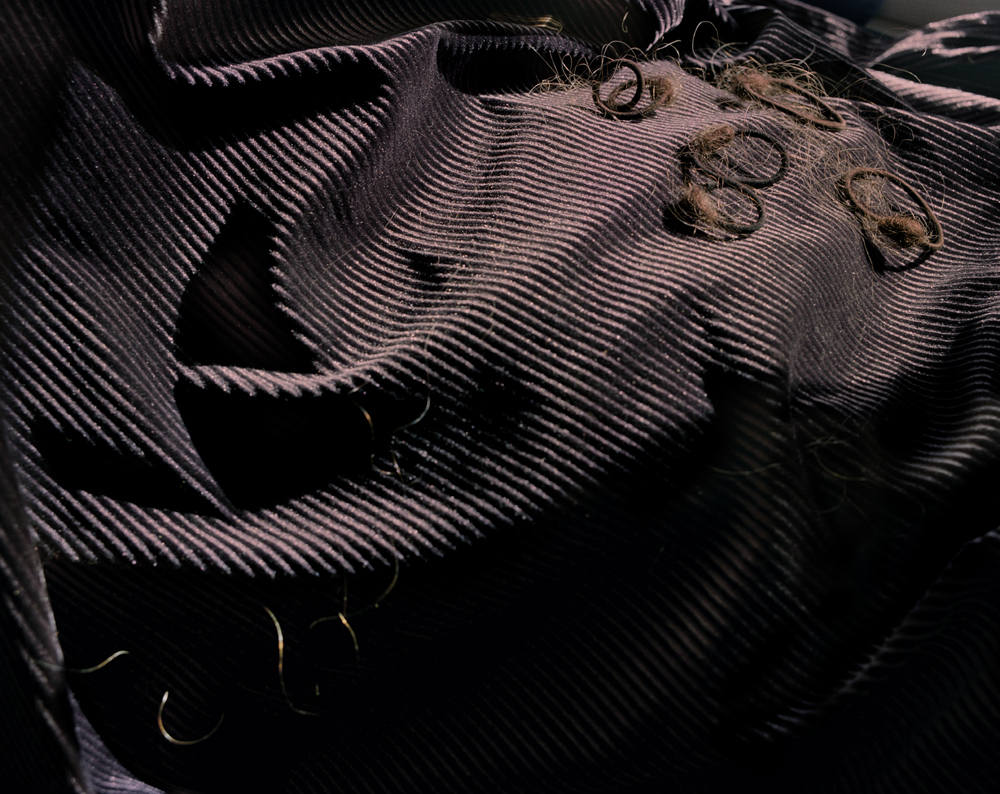
For me, the physical act of wandering evokes a psychological wandering. Much of my work is influenced by writers and poets, using the landscape or everyday objects as metaphors that reflect a more interior state. Paradoxically, I’m interested in photography’s inability to tell a complete story, drawn to its silent language, fragmented nature, and the evocative space that lies between. I think of myself as a character caught in a narrative behind the fragments of images: using the animals, the light, and the suburban plant life as my compass to getting lost. . The photographs are visual contemplations. I put together the fragments like pieces of a puzzle, trying to understand my own psychology and obsessions through the external world. The accumulation of these disjointed images come together to form a world that is more fictional, as it becomes more about the way a place is seen by a particular character, than the place itself. The animals are my messengers or doppelgangers, light and color become more of a lyrical thread, accentuating the changing moods of the landscape. The still lives of hair, being the most personal, represent my own undoing throughout this elusive and obsessive search.

I’m a wanderer caught in the day’s unraveling. 


Monday, June 10, 2013

Pascal Amoyel


Pascal Amoyel has a degree in photography from the Ecole Nationale Supérieure de la Photographie (ENSP Arles). His work analyzes the way people inhabits places and how both of them interact. He explores the distance that goes from the neutrality of documentary style photography, to the subjective glance peculiar to the photographic process. Pascal collaborates with fellow Light Leaked photographer,  Thomas Bouquin on photographic projects. His work had been exhibited and published widely. Pascal lives and works in Paris, where he also writes about photography and curates exhibitions.

View more of his work here 


L’aphélie (Aphelion) Project Statement 


This series was realised in the south of France during the few days of July 2012 when the Earth was at its longest distance to the sun.
This appears to be a time of lowest speed in the orbit, when people slowly drift in makeshift vessels.

" Do you sense the secret, deep meaning of that adventure, when a delicate and pale graduate goes out all alone, through glass doors, from a safe harbour into the immensity of a July night ? Will he ever wade through those black marshes, swamps and chasms of the endless night; will he disembark on some morning in a safe port ? How many decades will that black Odyssey go on ? "

Bruno Schulz, A July Night, 1936.