Showing posts with label Quiet. Show all posts

Monday, October 6, 2014

Frank Hamrick


 I have been an admirer of Frank Hamrick's photography and book arts for some time, and was inspired when I saw his work in person at the exhibition, Pathways, that just closed at the McMaster Gallery at the University of South Carolina. Below find a few insights Frank shared about his work and process.

Frank Hamrick is an associate professor at Louisiana Tech University. His work mixes photography, storytelling, handmade books and found objects. Frank received his BFA from The University of Georgia and his MFA from New Mexico State University. NPR has written about Frank’s handmade books and in 2012 Oxford American Magazine listed Frank as one of the 100 Superstars of Southern Art. His work is housed in collections including the Georgia Museum of Art and The Ogden Museum of Southern Art in New Orleans.


Ashley Kauschinger: What role does the personal play in your work?

Frank Hamrick:
I have made satisfying work of strangers and places I’ve visited, but most of my work is tied to my connection to places I have lived and people who are close to me. Photographer Christine Shank once said the most personal work is the most universal. I find that to be true as long as the work leaves an entry point for viewers to relate to the content.


AK: How did you get involved with alternative processes, and what are your thoughts about its uses in contemporary photography?

FH:
Digital photography has made things more accessible to people but also leaves many feeling removed from the process. These hands on, alternative methods being practiced can be seen as a reaction to the proliferation of digital processes, but there are also a lot of analog/digital hybrid processes being developed.

My bookmaking is a good example of blending analog and digital methods.

A few years ago one of my graduate students had been unsuccessfully trying to learn how to make tintypes. I did not know how to guide him. My solution was to start learning the process over winter break and then return to school and show him.

I usually challenge myself with learning something new each year, whether it is how to expose an image onto a leaf using its chlorophyll or how to create and document a camera obscura. Then I share that information to my students and peers.


AK: You are an accomplished book artist. Do your books inform your photographic work? Or do they communicate what can’t be said through photography alone?

FH:
People like my images on the wall but my photographs tend to resonate better with viewers when they are sequenced and presented as books, something the viewer can hold and turn its pages, rather than standing across the room looking at it on the wall in a “do not touch” situation.

If you were to think of a photograph in the same way you consider a single song, then an artists’ book is similar to an entire album of music complete with cover art and liner notes. The artists’ book allows me to combine imagery and text and incorporate materials, like handmade paper, and processes, such as staining and letterpress printing, to create unique or limited works of art.


AK: What is your editing process? How does it differ when you are sequencing a book vs. an exhibition?

FH:
When making a book I prefer to choose a photographic series that I feel is finished or at least there is a completed chapter in the series. I do not want to create a photography book of new work and then a week later make a new photograph that I wish was in that book. I spend a fair amount of time thinking about the possible connections that can be made between the images on the left and right spreads in the book. I also consider the overall arch of the story the images convey in the book. My books tend to have a small selection of images. Past books have ranged between 6 – 24 images depending on the project. It is not unusual for good images to be left out of a book because it did not fit in the sequence and story told by that particular book.

Exhibitions tend to be more open. I do think about the sequence in a show like I do in a book. But I take more risks, often showing new images or ones I am curious to see how people respond. Often my exhibitions include photographs that do not make their way into my books because over time they are replaced by new, stronger images.


AK: You are also an Associate Professor at Louisiana Tech University. How do you find balance between teaching, your artist practice, and life?

FH:
It is challenging to balance being a professor, a working artist and having any sort of personal life. Teaching has changed so much in the past ten years. Students expect their professors and course material to be accessible 24/7 now that we have e-mail and online class resources like Moodle/Blackboard. There are many more tasks attached to teaching now compared to when I first started.

As far as making artwork, I photograph my garden along with my family and friends as a way to balance making artwork and maintaining relationships and activities that matter to me. I blend trips to see family and friends with visiting curators and teaching workshops.

Photographer and Educator, Eliot Dudik, said something to the effect that artists do not get to stop for weekends and holidays. He is right if you want to get anything accomplished.

When I was a teenager, one of my mentors said, “You’re fucking up if you’re watching television.” I apply the philosophy to my life, asking myself, “How does this contribute towards my goals?”


Monday, July 28, 2014

Christine Shank


Christine Shank is an artist working predominantly in photography. She has exhibited in both solo and group exhibitions throughout the United States since 1998 and her artwork is in the Harry Ransom Center and the William Benton Museum of Art as well as several private collections. Shank has been an artist-in-residence at the MacDowell Colony, Constance Saltonstall Foundation for the Arts, Kimmel Harding Nelson Center for the Arts and the SIM Residency in Reykjavik Iceland. A selection of her “Interiors” series was published in 2008 through Booksmart Studios in a limited edition monograph titled She Quietly Considers. Shank has received funding through The Connecticut Commission on Culture and Tourism, New York Foundation for the Art’s Strategic Opportunities Stipend and The Midwest Center for Photography.

Christine Shank has a BFA in photography from Miami University of Ohio and a MFA from Texas Woman’s University in Denton, Texas. She currently lives in Rochester, New York where she is an Assistant Professor and the Director of the MFA program in Imaging Arts at Rochester Institute of Technology.


Ashley Kauschinger: Your series, our first year together, has a great variety of imagery. What is your thought process behind this decision and how do you still create a cohesive series? 

Christine Shank:
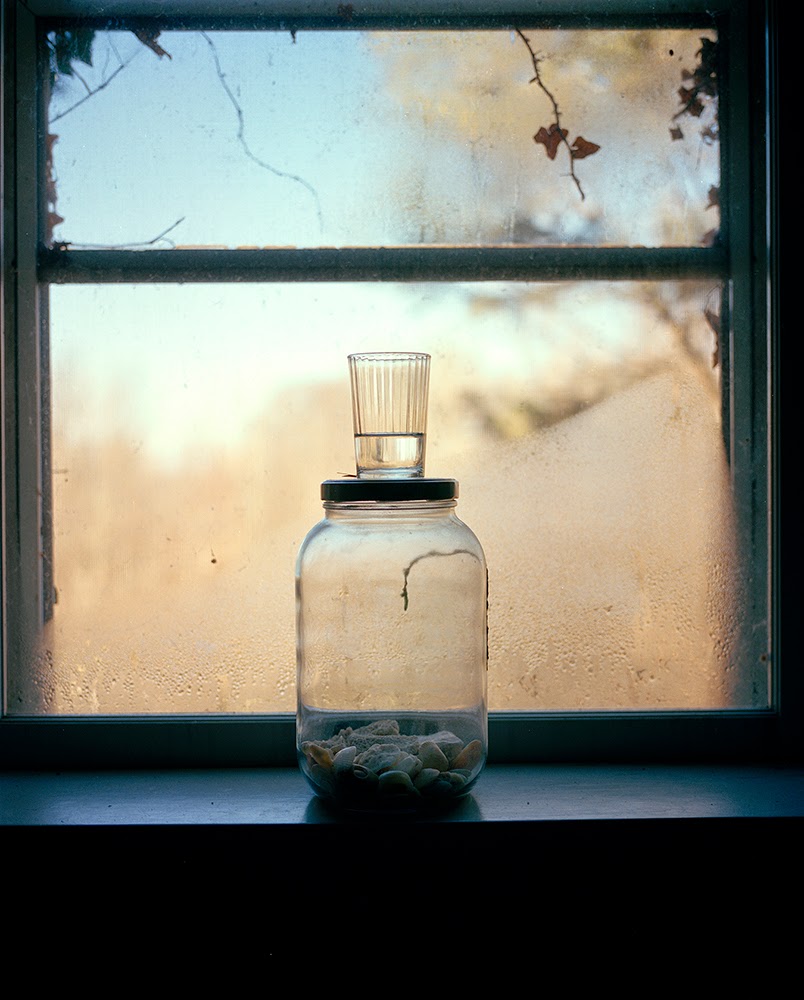
 Yes there are a variety of different types of images within the series. My ongoing project, our first year together, consists of images that seem unrelated but are bound together by their treatment and tone. There are images that hint at and reference one another while intentionally remaining enigmatic. There are images containing a trace of reference to other images within the series, like an icicle appears in one image and just the watermark from the icicle is in another one; the outline of scissors sun bleached into butcher paper that makes up a different image, nail holes in a wallpaper, blood stained tissues, all these images reference one another and contain a very ordinary type of everyday violence. I am interested in the way that images work together and against one another and how they suggest a very benign sort of disturbance. The sequencing pushes at the differences between the singular images to avoid the implication of any one specific narrative while the wide variety hopefully works to move the viewer through the whole body of work.


Within this series I have been really interested in pushing at what is thought of as a series of photographs. There are images that are highly constructed, to photographs where the only intervention is that I made a picture. Typically the subject matter, the locations, materials, photographic techniques, or methodology will be what binds together a series but with these images what holds them in relationship to on another is the quiet and often very subtle connection between them. This is what creates the tone I believe holds the images in conversation with one another. These images construct the moments in between points of significance, the way much of life is experienced in the middle of contemplation, conflict, and wonderment.


AK: What role does narrative play in your work?

CS:
The way I think about and engage narrative in my artwork has greatly changed over the years. When I was working on the Interiors Series (2004-2009) I was very interested in constructing a story to be contained within the frame of one image. That story was told through the scenes I built and the image’s title.

In my current body of work I am most interested in creating a sequences of images that a narrative cannot be easily drawn out of, so it’s the opposite of how I was once working. With this work I am most excited by the restraint needed to make suggestions without pointing to a direct narrative structure or creating a narrative arc. I am not interested in creating a singular narrative or even an explicit narrative. I hope for a feeling to emerge and a relationship between the images to be recognized and that the person viewing the work finds something in the combinations they can relate to. I know this is a tall order considering the speed at which most people consume images these days, especially online with Tumblrs, for instance, or in overwhelming hyper experiences like art fairs.


The title of the series, our first year together, is intentionally vague and creates more questions than answers. In fact I have been developing the series over many years—from 2009 – 2014. But I think the title matches the softness and suggestive moments within the photograph while creating a time period in which to consider the images. A few years ago I had a review with curator Roy Fulkerson and he said, “don’t play what’s there, play what’s not there,” which is a quote from Miles Davis and it fits how I am thinking about what emerges from our first year together.


AK: What influence does literature and poetry bring to your photographic work?

CS:
I feel connections between photography and literature. What I draw the most inspiration from is what I read and what I experience in my day-to-day life. I recently read Rage of Poseidon by Anders Nilsen, Mumbai, New York, Scranton by Tamara Shopsin, Path by Rebecca Solnit & Elin Hansdottir and Can’t and Won’t: Stories by Lydia Davis. For different, and some overlapping, reasons these books are really inspirational to me right now. Jeffery McDaniel is my favorite poet and has been for a number of years. I always go back to his poems and always feel something stir in me when I read them. Diane Ackerman, Annie Dillard, Malcolm Gladwell are also writers that I am inspired by and always enjoy reading. The way they can create a story about the fragility of being human while also examining nature, society, economy, and exploring their own curiosity through stories is wondrous to me.

My husband has recently been reading books on the origins of the essay and the conversations we’ve had as a result have caused me to think about sequencing images in a very different way and inspiring me to sketch new images to create in the studio.


AK: Take us through what a day of creating art is like for you. What environment do you create for yourself?

CS:
I really prefer being alone when I’m working. I figured out pretty early on that socializing and making art don’t fit together for me; even when I’m just scanning negatives I prefer isolation. Over the years I have had really wonderful studio assistants but I have never been able to really make my work with anyone else around. I like it to be quiet, no phone, no internet, sometimes no music. My studio is a very private place where I can play, make messes, make mistakes, consider things and walk away from something leaving it right where it is knowing that it will be there when I return. I have a phrase taped to the back of my studio door – expect nothing– which is what I strive for when working. Holding that in mind keeps me open to surprises. I am a very organized person when I teach and I try to be tidy in my home and office space at work, but in the studio I am none of those things. In the last decade I have had 5 different studio spaces and the ones that worked best for me were those where I left home to go to the studio. Even just a mile away is enough for me to separate myself from the other responsibilities of my life and to enter the working space of the studio. In recent years I have started to do residencies and in those months or weeks away I am the incredible productive. There is something really uncomfortable and helpful to me in the window of time where everything is new, uneasy and unsettling, I feel a heightened sense of awareness and am very sensitive and productive in that time.


AK: You graduated with an MFA from Texas Woman's University 10 years ago. What advice do you have for photographers navigating the world after graduate school?

CS:
I think post-graduate school you have to really be honest with yourself about what your priorities are and what is most important to you. I believe you have to figure out what you enjoy doing and how you want to spend your time. During graduate school, time is really devoted to your growth and experimentation as an artist and students have to work within the requirements of a specific program. Other than the program’s guidelines it’s really about you and your work. When you are done with school you have to get really clear with yourself about what you want and what you are willing to do to have what you want in your life because no one is holding you accountable for anything anymore.


I chose the path of teaching as a way to make a living and support my art. I’ve been really fortunate and I started teaching full-time directly after grad school. This has worked out well for me and I have been fortunate to work in supportive universities with colleagues who have helped me grow as an educator and artist. I have friends who have chosen other avenues and I talk to my students about the variety of jobs and careers that may be a good fit for their lives post grad school. I think it’s important to remember no path is easy and no choice is wrong, you have to figure out what works for you.

Also I think the quote in my studio I mentioned earlier is good advice in it’s many interpretations: expect nothing.