Showing posts with label Autobiographical. Show all posts

Monday, May 4, 2015

Lynné Bowman Cravens


Lynné Bowman Cravens was born and raised in Austin, TX. She grew up learning painting, drawing, and sculpture from her mother, Brucie Bowman, who is an accomplished artist. Cravens was first introduced to photography as an art form during a summer workshop at The Art School at Laguna Gloria. Cravens received a BA in Photocommunications from St. Edward’s University in the spring of 2009. She is currently working toward her MFA in Photography at the University of North Texas, scheduled to graduate in May of this year. She currently resides in Denton, Texas.


Artist Statement: Vessel 

The series, Vessel, focuses on the body. Through meticulous physical distortions and transdisciplinary techniques I create pieces that deal with personal experiences, identity, and our physical forms. Vessel is autobiographical in nature, however each piece in the exhibition deals with the body in some way. We are forced to experience the world and each other through our physical bodies. Our body becomes a vessel for our thoughts and experiences, housing all of our hopes, fears, and memories. While each piece in the show addresses a different experience, the overall exhibition showcases the many complexities present in a single individual.


Monday, December 16, 2013

Margaret Cogsdill


Margaret Cogsdill, originally from Atlanta, Georgia, received her BA in Philosophy from The College of Charleston in South Carolina. Later she studied photography at Georgia State University and The Savannah College of Art and Design. In 2013 she received her MFA in Imaging Arts from Rochester Institute of Technology. Her work explores themes related to memory, loss and nostalgia. She is currently a contemporary artist based in upstate New York.

View more of Margaret's work here


Artist Statement

The Space Between Us explores the notion of loss as an overarching theme by examining a mother’s illness and its profound impact on her daughter. My work is inspired by a desire to understand my relationship with my mother, Caroline. Throughout my life I have struggled to accept her illness and its impact on me. Through photography, performance, and imaginative play I am able to initiate a new relationship with her and to explore intimacy, connection, nostalgia, and loss. Through this body of work, my mother and I enter into a world of our imagination where we collaborate as artist and mother. We work from a desire to express a time before she was ill and to recognize and reinvent who we are now, and who we can become in the future. As a daughter I turn my lens towards my mother as well as towards my own legacy. I incorporate the familial through a lineage of women and investigate the domestic spaces they inhabit. I look to my grandmother’s house and the surrounding landscape as a place of refuge and contemplation while also shedding light on feelings of fear, melancholia, and disorientation. Woven together, these images create a narrative that speaks to the complexity, richness and ambiguity of our relationship. he fragmented narrative relects my inability to wholly make sense of my mother’s illness. I have struggled to understand, but I am let trying to embrace the uncertainty and meaning of my circumstances.


Monday, November 11, 2013

Margaret Hiden

from An Unfamiliar Landscape 

Margaret Hiden is a photographic artist and educator based in South Alabama where she is an adjunct professor of photography and art at Pensacola State College. She holds a B.F.A. in photography from Birmingham-Southern College and graduated at the top of her class with an M.F.A. in photography from the Savannah College of Art and Design in Atlanta. Her personal work and research explore themes dealing with the photograph’s function; specifically, those that incorporate appropriated and original imagery leading to commentary on philosophies of the medium that pertain to memory. She has a particular obsession with and interest in the extinct, Kodachrome transparency. Margaret exhibits on a national level and has been internationally recognized.

View more of Margaret's work here 

from 15 Glenview Circle 

Ashley Kauschinger: Briefly describe your series 15 Glenview Circle and how that informed or transitioned into your next body of work An Unfamiliar Landscape?

Margaret Hiden: Describing 15 Glenview Circle in a brief way is difficult. What led up to it was important. For a long time I had wanted to explore my grandfather’s disease of dementia, but I wasn’t sure how to do that, or go about that.

AK: How long did he have dementia?

MH: Let’s see, he was about 86 when he passed, and he literally passed 3 weeks after my thesis show, so for several years. He started to go downhill after my grandmother passed away. Which was 4 years before that. The family had been dealing with his disease for a long time. It was something that was important to me, and even looking back on it now, a lot of people ask me if I am dealing with my own fears in that body of work, and it definitely does. It is thinking about our significance and what does it all mean. If you don’t have your memories what do you have? I would rather die of cancer. So, I knew I wanted to explore that, but I didn’t know how to do that. I knew that I didn’t want to go take pictures of an old man dying in his chair. We have seen that. 

AK: Such a literal documentary style.

MH: Yeah—not in a documentary style. We have seen that before, and people have done it well before. It wasn’t for me, but I knew that this was something that I wanted to explore. So, I was in school in Atlanta, and I was close to Birmingham (Hiden’s hometown). I frequented there quite a bit, and would always go visit my grandfather. We were sitting at his house one afternoon, and I  was noticing all the pictures in frames that were surrounding me all over the house. He had a table sitting in front of him where he would play cards and count out money. He had an obsession with counting at the time because of his dementia. Every time I would go over there the pictures would change of who was sitting in front of him that day.

from 15 Glenview Circle 

AK: Did he recognize that photographs that were surrounding him?

MH: I don’t know if he did recognize them. a lot of people have asked me if I have ever showed him this body of work. And I haven’t because to me that was never what it was really about. But your question of if he recognized that photographs is really one of the questions that lead me to creating “15 Glenview Circle”. I started thinking about that, and all these childhood memories came back to me. One of them being sitting in my grandfather’s lap and looking through the newly developed 35mm prints and negatives that just came back from Walmart. My grandfather was always an amateur photographer. He always had the camera and family events. It didn’t occur to me until I started this body of work that I always had an interest or connection to the medium. I started thinking about photography and memory. I was curious if photographs had the power to stimulate memory in people who have memory loss disease, like dementia. That started to get me to think of how I can explore this thought and turn it into a visual statement.

So around this same time I was over at my uncle’s house. And sitting in his basement, sitting around deer heads and taxidermy animals was a projector of my grandfather’s old Kodakchrome slides. I decided that I would scan them in, and give them as gifts to my family members. At the time I didn’t think about that I would use the images to make work. As I was scanning them, I started to feel that these slides were a resource. The next time I was at my grandfather’s house, I was thinking how I could incorporate these slides, and I started to see his house as a metaphor for what was happening to his mind, small things that maybe only family members would know. Say, a pair of shoes that had been sitting on my deceased grandmothers side table for 6 years. Things that stood still in time. Dust that was collecting for years. Cracks in walls. Things that were falling apart. Holes in walls that were covered up by paper plates. Nobody was there to take of it. The ironing board had been upright for years, and not moved since my grandmother last used it. I started to see the space as this stillness in time, and a metaphor for what was physically happening to his mind. I just started to shoot the space because it started to mean something to me. I had the space, I had these old slides and they came together as a commentary on the present, absence, passage, fragmentation of memory, two frames are in each image, creating a past and present.

from 15 Glenview Circle 

AK: How did you decide on the specific aesthetic of 15 Glenview Circle?

MH: A lot of it was experimentation. Layering in Photoshop. But that decreased, as I started to know what I needed to shoot at the house. What perspective I needed, what kind of light or color. I knew each shot needed some kind of window or doorway to serve as a portal, transition or passage.

AK: That also relates to photography in general, a photograph being a window or passage, and to memory in general.

MH: Yes, freezing that moment in time. That idea that really anything photograph is a memento mori. In each frame the “present” is always there—the present at the time, which was the space that was still there. The line in the middle of the images is basically from the scan. Which I choose to leave in to comment on the process. The fact that I am scanning in these Kodachrome slides is important to the images. But the line also started to serve as a dividing line between the past and the present. The line is usually going through a person—blurring the lines.

AK: That line to me, always seemed like a skip in the brain. Like a blind spot, turning your head only to see a blackness.

MH: It definitely enhances the idea of fragmentation. A lot of people have compared that body of work to moving pictures. Like a glitch in a film, where is skips, and something is not quite right.

from An Unfamiliar Landscape 

AK: Can you talk about what An Unfamiliar Landscape meant to you when you started finding what that work was about?

MH: Yeah, part of my problem is that I feel like I always need an idea before I even start, and that never works. So it was it was more about me exploring the materiality of the slides, and what had happened to it over time. Time has taken over the memories within these images. As I was scanning them in, there would be images of landscapes, football games, birthday parties, things that families do. But certain ideas of the slides would be more damaged than others. So what I would do is appropriate these images by scanning them in at a high resolution, and curating an area of the image to create a whole new photograph. Taking some context out, and leaving some in to create new meaning. They started to look apocalyptic. Like bombs going off. This made me start to think about my own fears, and thinking about me loosing my own memories, forgetting things, and thinking about significance. This was more about those fears within myself by creating the landscape of time.

from An Unfamiliar Landscape 

AK: Did you manipulate these images in any further way than how you found them in the box?

MH: Yes, I have. I think I wouldn’t feel right if I didn’t change them in some way. I am all for appropriation, but I feel like I need to do something to it. In Photoshop, in specific areas, I would make selections of the deteriorated areas and maybe duplicate it and put it in an overlay mode to enhance that area of the photograph so that it stood out more than the others. There is a lot of masking that is done. I am not going in there and changing the saturation.

AK: But you did not further take a match to the physical slide?

MH: No. I haven’t done that. For this, everything you see on the image has happened through time, or from my uncle’s hand. I just enhanced areas.

from An Unfamiliar Landscape 

AK: What do you think the emotional difference was between 15 Glenview Circle and An Unfamiliar Landscape—where there is must more deterioration?

MH: They are very different. I’m more emotionally tied to myself in An Unfamiliar Landscape. I am exploring why I am interested with these objects, and working with them. I think that it is my way of holding on to my past, and my childhood. When my grandfather died, I was 30 years old. And for me it signified that it was time for me to be an adult. I have so many memories of being at my grandparent’s house, and the death of both of them really ended that.

AK: I totally understand that because it doesn’t matter how old you get, whenever you go to the place where you were a child, something about you is either treated like a child from your family members or how you emotionally feel in that space reminds you of those feelings. It is totally a death of that.

MH: It is, and with An Unfamiliar Landscape, I am dealing with the objects that keep me tied to that place. But it has more to do with me, then 15 Glenview Circle, which had more to do with my grandfather’s disease when he was alive. When he died, that work became more about the space. I didn’t realize when I was doing that work how much I became attached to that house. Since then, my cousin has moved in and it is totally changed. I never got to go photograph the house after my grandfather died. I felt like something was missed, photographically because of that. I think that is why I am also working with these slides because I didn’t have the opportunity to go see what might have happened with the spaces. So the Unfamiliar Landscape is my way of creating that missed space.

from An Unfamiliar Landscape 

AK: You can see the connection between them, but they feel like totally different spaces.

MH: Yes. It is interesting. I showed that work at the Art Papers Auction, and I was shocked that young people were so interested in the series. I think there is something modern about it, even though it comes from film and an analogue process the way is has been manipulated I think makes sense to how young people process photography and artwork.

AK: Yeah, there is nostalgia about Kodachrome, especially since they stopped making it.

MH: The thing is, even though I talk about it in my statement, many people don’t know what Kodachrome is. Well that is interesting to think about. On top of the work being about photography as a medium, nostalgia, and talking about memory and how we use photography—the materials are also extinct, they have died out now.

AK: Yes, something that has been hard for me, is that I am in love with processes that are going away. I just started working with slide film two years ago, and Kodak isn’t even making it anymore. What does it mean to fall in love with processes that feel like “how long can I love this for?”

MH: So maybe part of the work for you and for me is just about our love of photography, for the material. We want to preserve something and make it an art.

from An Unfamiliar Landscape 

AK: It seems like it often happens that when something becomes commercially irrelevant, that artists picking it up as what they use. And about film, for awhile I felt like artist would be able to use film for awhile, because I was thinking about all the alternative processes that still exist, but then I remember that film has to be made in batches in factories, you can’t really make it one sheet at a time.

MH: Yeah, I think the issue that happens is that you have the small group of artists who want to use these materials, and then there are the companies that are not making money to the masses like they used to. So they are not thinking about catering to this smaller group of people still using their products. This feels like it can degrade photography. But then I think about how I am an avid Instagram user, and am I degrading fine art photography by participating in Instagram? Do we need slide film to create art?

AK: Sometimes I feel like I need my 4x5 camera--I need my film. Because I need the validation that I am an artist, because look at my materials. That might sound stupid, but it is really hard to have confidence in yourself as an artist. I feel like you are already questioning yourself so much, it is really easy to convince yourself that your work is stupid or it is irrelevant or other people can be an artist, but I am not meant to be an artist. So I feel like using a process that not everyone uses or that I know is beautiful validates me.

MH: That brings up the question of can the vernacular be art? To me, that is why I have loved the processes I have gone through in my work. Because I feel like have taken something that is mundane, something that is not even a good snapshot, and totally re-contextualized it into art.


Monday, August 26, 2013

Ayala Gazit


Ayala Gazit was born in Haifa, Israel in 1984, and was raised in Tel Aviv by an American mother and an Israeli father. She started photographing at age 15, and quickly fell in love with photography as an art form as well as a language. When she was 18 year old she was drafted to the Israeli Army, where she served for two years as a military photographer in a highly classified unit in the Intelligence division. In 2005 she moved to New York to complete a BFA in photography at The School of Visual Arts. Ayala graduated with Honors in May 2009, and was fortunate enough to be chosen as the single student to receive the Tierney Fellowship. Thanks to the Fellowship's support she managed to begin the project, “Was it a Dream",which she has been wishing to embark on for over a decade. This summer she will begin her MFA studies in the International Low Residency MFA program in photography in The University of Hartford.

View more of Ayala's work here and here 


Was it a Dream Statement 

When I was 12 years old my father told me that I have an older brother named James, who lives in Australia. My father and James at the point have been sending each other letters for a number of years, however they have yet to meet or hear one another’s voice. Uncomfortable being the eldest grandchild on both sides of my family, I became obsessed with the possibility of an older brother. I never had the chance to meet James, he committed suicide in October 1996. This work is my attempt to create a portrait of my brother whom I will never meet. When photographing the “Unphotographable”, by following the traces and echos of ones existence after his passing. Thanks to the Tierney Fellowship I received in 2009, I traveled across Australia to meet James's family, who thankfully accepted me as one of their own. The work I created consists of family snapshots, letters and quotes from conversations, alongside my own images taken in Israel and Australia.


Monday, July 15, 2013

Aaron Blum


Aaron Blum's series "Born and Raised" is currently being exhibited until July 20th, at Silver Eye with the work of his mentor, Doug Dubois. Aaron took the time to answer some of my questions about his work, and how this exhibition came together. 

As an eighth generation West Virginian, Aaron Blum creates art deeply linked to his home state. His unique personal history inspires his creative work, which contrasts Appalachian stereotypes with representations of an upper middle class heritage. Aaron is a graduate of both West Virginia and Syracuse Universities. He is a past Syracuse Humanities Center Fellowship recipient, Jurors' choice award winner for Santa Fe's Center project competition in 2011, has been selected by Magenta as a photographer to watch in 2012 and has exhibited widley around the country. He has shown his work at such venues as The Houston Center for Photography, Newspace Center for Photography, The Philladelphia Center for Photography and the Silver Eye Center for Photography. He is also in the permanent collections of the Haggerty Museum of Art and the Houston Museum of Art. Aaron is currently an adjunct instructor at multiple institutions such as Carnegie Mellon University and West Virginia University.

View more of his work here


Ashley Kauschinger: How did your series "Born and Raised" begin?

Aaron Blum: "Born and Raised" started very organically and suddenly. I came out of undergraduate school making less than average work, it was a lot of Crewdson ripoffs to be honest. I had a lot of vision, dedication and technical skills with a camera, but no real direction. I went to grad school and they immediately made me want to cry and go back home, and they should have! I kept with it though, and during that period when I was trying to find a valid subject, my grandmother and I got into a conversation. It was very innocent, I dont even remember how it started, but the subject was of my heritage. My last name is Blum (rhymes with plum) and it is German in origin so I just thought I was German. She looked at me and said you're not German, you are probably 90% Scots-Irish. This really got to me. My grandmother started pulling pictures from over one hundred years and telling me stories about my ancestors and their journey to America. She explained how many of them were college educated, including almost all of the women, from the 1850's on. There were so many incredible stories and relatives that were prominent figures in the community. This blew me away and sent me into somewhat of an existential crisis. I had to find out who I was, where I come from, who were all these people, and how they all linked to Appalachia. This occurrence paired with me leaving West Virginia long term, only to find out what others thought of my home, really set the project into motion. I started realizing people from outside the region had a very skewed idea of Appalachia. I was always aware of the stereotypes of Appalachia, but I just assumed that people thought they were just bad jokes and not a reality. I guess I was wrong. People would often ask me earnestly, and never maliciously, ridiculous questions like: "Why do you have all your teeth?" or "Why do you have shoes?" These stereotypes and many others, my understanding of what my home actually was, and my desire to find out my heritage set in motion my constant need to find out what it means to be Appalachian.


AK: The series is divided into two chapters. Do you view these sets of images separately? How do they inform one another?

AB:
They are set up as two different chapters, but they are the same project, and it will be ongoing for the foreseeable future. The first chapter "Reflections of a World Set Aside" is really based on my idea of my family and life in Appalachia. "Floodplains, Coal Trains, Kudzu Vines" was looking at my home a little bit differently. I was thinking more about the river culture, I grew up on the Ohio River, and thinking more as a traditional southern photographer. I think they work very well together and I often edit them together for exhibition. I think it was just a good way for me to tell different chapters of the same story. West Virginia is a very segmented state. Each section has its own identity and I'm interested in exploring each one. For example the Northern Panhandle is very different than the southern coal fields and the Eastern Panhandle. Finding out exactly what the differences are, but finding the way to identify with it all personally, is what I'm trying to do.


AK: How do you view the myths surrounding Appalachia? How do you feel this work aligns or challenges those ideas?

AB: I think the stories and myths surrounding my home are mostly wonderful but sometimes include terrible stereotypes. The hills and rivers in West Virginia provide a feeling of isolation and freedom to people who connect with the region. The way it looks, the light, the mist, it all lends itself to those artistic ideas and myths. I love the idea of Appalachian minstrels, and the oral history tradition that they would use. It fascinates me. At times I feel like a modern Appalachian minstrel making my own stories and myths, but my version incorporates and questions stereotypes of Appalachia all at the same time. I feel like by making my own Appalachia I can guide someone to understand how I feel. I'm not sure I can change others opinions, but I do feel like I can place them in a world that may challenge their preconceived notions. Even if that world does live between fiction and non-fiction.


AK: In your statement you discuss how the character in the series are exaggerated versions of your friends and family. At what point does the larger narrative about Appalachia intersect with the personal? How much of this work is informed by the autobiographical?

AB: I think at every point my work intersects with my personal experience and the larger idea of Appalachia. My work is very informed by my experiences. I am constantly talking to people and trying to have new adventures to draw from. I think being in the region constantly to make new work or just to be there to take it all in really helps. My friends and family all still live there and I make a point to go down a lot. It also helps that I teach at West Virginia University. My work is always informed by both things, my life in the hills and the stories that surround it. Apart from all the time spent there I am constantly researching and reading about the idea and fiction of the place. It is all just an effort to understand what it means to call yourself an Appalachian.


AK: Can you talk about your current exhibition at Silver Eye with Doug Dubois? How did this exhibition come about, and what was the process of putting the show together?

AB: The show at Silver Eye really came together quickly. Ellen Fleurov curated it and really wanted to talk about the ideas of mentorship in photography today. I have known Ellen for a while and she was interested in my work, and Doug just finished up his project and the timing just made sense. There are a lot of connections in our work, not only in how we both shoot similarly because he taught me, but in the context of the work as well. So it seemed as if the work would hang well together, and I believe it does. The process of the show was not overly complicated. Ellen reached out to me and I reached out to Doug and after a week or so of discussions things were moving and we sorted through the images to find the best way to show the work together, and then the work was on the walls. Shortly after that Doug and I were trying to figure out what to say to a gallery full of people about the mentor men-tee relationship, and then it was over. We have gotten a lot of press on the show so it has been really exciting for me, and I cant wait to see what's next and I'm really thankful it has all come out the way that it has.


Monday, July 8, 2013

Chelsea Welsh


Chelsea Welsh is a photographer from Walbridge, Ohio. She received her MFA from Massachusetts College of Art and Design in 2013, and a BFA from Bowling Green State University in 2009. She lives and works in Cambridge, MA as the Residence Director of a transitional group home for adults with mental illness.

View more of Chelsea's work here


Disquiet Statement

I was the world in which I walked, and what I saw
Or heard or felt came not but from myself;
And there I found myself more truly and more strange.
-Wallace Stevens

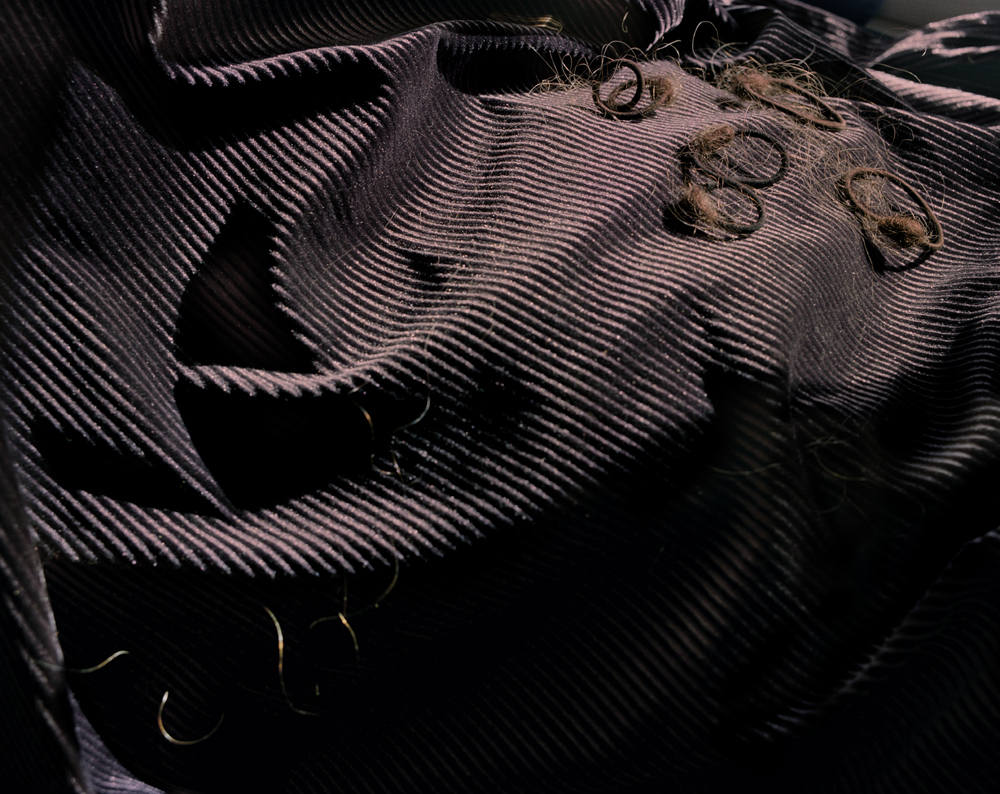
For me, the physical act of wandering evokes a psychological wandering. Much of my work is influenced by writers and poets, using the landscape or everyday objects as metaphors that reflect a more interior state. Paradoxically, I’m interested in photography’s inability to tell a complete story, drawn to its silent language, fragmented nature, and the evocative space that lies between. I think of myself as a character caught in a narrative behind the fragments of images: using the animals, the light, and the suburban plant life as my compass to getting lost. . The photographs are visual contemplations. I put together the fragments like pieces of a puzzle, trying to understand my own psychology and obsessions through the external world. The accumulation of these disjointed images come together to form a world that is more fictional, as it becomes more about the way a place is seen by a particular character, than the place itself. The animals are my messengers or doppelgangers, light and color become more of a lyrical thread, accentuating the changing moods of the landscape. The still lives of hair, being the most personal, represent my own undoing throughout this elusive and obsessive search.

I’m a wanderer caught in the day’s unraveling. 


Monday, July 1, 2013

Carrie Will


Carrie Will is a photographer and a New York native. Her camera is always aimed at people and the relationships in her life, especially the relationship she has with her twin sister. Her photographs document and often exaggerate the space that lies between their similarities. Photolucida named Carrie one of the top 50 photographers in 2012 via the Critical Mass competition. Will’s work is held in various permanent collections including the Smithsonian American Art Museum in DC and The University Art Museum in Albany, NY. Her work has also been seen in many galleries nationally and internationally, most notably at the Center for Photography at Woodstock, Michael Foley Gallery in NYC and the Australian Center for Photography. A solo show of Carrie's photographs will open in November 2013 at the SRO Photo Gallery in Lubbock, Texas.

View more of Carrie's work here


Ashley Kauschinger: How did your series, I am Redundant, begin? Did this feel like work you needed to create? What has this work taught you about your identity?

Carrie Will: The series entitled, I Am Redundant, began when I found myself in Syracuse, NY. I was cold, isolated, lonely and broken hearted. I was an MFA candidate at Syracuse University and life didn’t feel easy (I should point out that being cold is the only thing I blame Syracuse for). Eventually I hit bottom. One broken heart, one totaled car (with no injuries) and lots of sadness seemed to be the right recipe for art making. Despite all my dwelling in the past eventually I realized that what was in front of me was what mattered the most and I started making pictures of my twin sister and myself.  


Making pictures of Rikki and I was not new to me. I had done it before and I had actually fought the idea of doing it again for no good reason. Perhaps I wanted to be sure that the images were being made out of necessity and not ease. After eight years of photographing our relationship I can safely say that this is work I needed to be making. Creating I Am Redundant has taught me that I am one person as well as two and that my understanding of my sister and myself is always changing. When I started making the work I wanted to answer questions, to create visuals of how connected Rikki and I are but what I got were lots of questions with lots of possible answers. I believe good photographs should ask more questions than they answer. Similarly, the definition of my identity is always shifting and changing. Sometimes I think I know the truth, other times I feel as though I know nothing. Making this work has taught me that the not knowing is okay too.


AK: In your statement, you talk about creating a visual language that you can use to discuss your relationship with your twin. Do you feel this language was developed naturally, or was labored into existence? What do you feel a visual language can say that words cannot?

CW: The only thing I labor over, when making images, is getting the colors right. Other than that, the process is pretty easy and natural. I’ve always been interested in the way in which people communicate, whether it’s words that are spoken or written, glances, body language and gestures. I love the idea of it, the shortcomings and the successes. I am also obsessed with the idea of communicating with no gestures or language. This stems from the fact that the bond between twins is defined by moments of knowing and understanding another human beings almost as well as you can understand yourself. This ‘knowing’ has little or nothing to do with words. 


When my sister went into labor I dreamt that she had the baby and all was well, when I woke up, I had two text messages. One saying she was in the labor, the other saying she had the baby. I missed the messages but I knew. It’s experiences like this one that have driven me to create a visual language. Words can be beautiful but often language fails us in its finality. An image creates a language that changes depending on who’s looking at it and what they have brought to the image. I want my images to communicate as clearly as any human can. I expect them to tell the truth as well as lie a little, to speak clearly and yet be misunderstood sometimes, to ask lots of questions and to only answer the necessary ones.


AK: The narratives that you create are varied, complicated, and strong. They have a flowing rhythm and are not repetitive. What are your thoughts on creating individual narratives within a series, and getting down to the final edit of images? Some photographers have a belief that all images should be in the same lighting, or all taken inside. Your variation suggests a different mindset.

CW: Thank you for the kind words about my work. When making work that features the same two people over and over my fear is repetition. It’s always nice to hear the words ‘not repetitive’ in the same sentence in regards to ‘I Am Redundant’. I love stories, which is why I love photography. I think a series of photographs should tell a general story and each image within it has a responsibility to tell a different story within the framework of the main theme. I believe they can vary and differ and even be at odds with each other but overall they always point us back to the whole. The full title of the series is 'I Am Redundant, Half of a Whole, A Freak, Identical and Lucky'. Each image has it's own narrative but can find it's place somewhere in that sentence. 


I have a few rules that I follow when making images. I almost always shoot in natural light, I always shoot landscape orientation, I only shoot Kodak Portra film and I shoot with a 4x5 view camera. I used to have more but I have lightened up a bit over the years. I find the formality of these things forces me to think through the image just enough. I like having a plan and then completely changing it at the last minutes. I also love happy accidents, otherwise I wouldn't put myself in the images. When it comes the making of each image and the meaning inside of it, my process is always different. Perhaps that’s where the variation comes from that you mention.


AK: Finally, what is your process of self promotion? How do you balance life and creating work?

CW: Self-promotion can be tricky. I consider it part of the process of art making but if not careful it can take up a lot of precious art-making time. I reserve time in my week to do research about upcoming shows, grants and residencies. Conferences are a good place to network and I make sure always to follow up on contacts and send ‘thank you’ and ‘it was nice meeting you’ messages. I have been pretty lucky and I am so grateful to the people who find me via my website and include me in things to help promote my work. Thank you, Light Leaked!

I find balance between life and making art to be always influx. Some days I get it evenly split, other days it’s all off but that’s what balancing is, always changing and shifting. I try not to be too hard on myself. For years I taught photography as an adjunct instructor at different colleges. Making art was almost impossible for me because I felt like I was always spread too thin. I know people that can make it work, but I couldn’t. Now I teach yoga, I practice yoga and I make art. Balance feels easier now that I enjoy all aspects of my working life.