Showing posts with label Narrative. Show all posts

Monday, December 14, 2015

Rachel Jump


Rachel Jump's black and white work explores themes addressing ideas of home, belonging, memory, and absence, and have been exhibited throughout the United States. Rachel is represented by Alibi Fine Art in Chicago, IL, and had her first major solo exhibition in November of 2015. She graduated from the Rhode Island School of Design (BFA PH’14), where she received the Harry Koorejian Memorial Scholarship in 2013 and the Haining Family Scholarship in 2012. Her photographs are a part of the RISD Museum Special Collections, where she was also a visiting artist in conjunction with the exhibition, America in View: Landscape Photography 1865 to Now, in 2012. Rachel has taught at the Nantucket Island School of Design and the Arts and Maine Media Workshops + College and spent the last year working as a studio assistant for the photographer, Arno Rafael Minkkinen. Rachel lives and works in the Chicago area.

Rachel's solo exhibition, Origins, is currently open until December 24, 2015 at Alibi Fine Art in Chicago, IL. She will be giving an artist talk in conjunction with the exhibition on December 19, 2015 from 4:00-5:00pm. Check it out if you are in the area!


Artist Statement: Origins 

The core of my photographic practice stems from a place of pure empathy- a desire to share my story within the collective human experience. My visual trajectory has always centered on the disparate nature of my own family, and my desire to reconnect us.

For most of my childhood our lives were scattered over countless households. My disparate memories of these places merely composed a fragmented idea of home. Later in life I began to question how my identity was shaped without a point of origin. Photography provided a way in which I could eternalize these fleeting moments, a fiction entangled by my truth. As a way to cope with these feelings of isolation, I created a narrative hoping to connect these places and reunite my family. Through this shared experience, my family and I appear to search for one another within the various environments that divided us. As a result of our efforts to find solace and intimacy, I conjured a myth of a home; a sanctuary where my loved ones and I could finally belong.

My photographs are relics of loss; traces of a family that I tried to piece back together.


Monday, November 2, 2015

Nicole Akstein


Nicole Akstein was born and raised in Atlanta, GA in 1985 to Brazilian parents. She received her BFA in Photography in 2007 from the School of Visual Arts in New York. She has freelanced for publications such as The Village Voice, Atlanta Magazine and Blender Magazine. Akstein's work has been exhibited in Georgia and New York. Her work explores ideas surrounding identity, gender, culture, and societal and social structures. Most images are shot with traditional black & white or color film, in 35mm and 120mm formats. In addition to photography, she has integrated video, light projection and mixed media installations into her work.

Akstein is currently based in Athens, GA, where she received her Masters of Art Education and Certificate in Nonprofit Management from the University of Georgia in 2014. She has taught art to students in pre-K through high school at various schools & community centers in Georgia, Brazil and India. She is the Arts Outreach Coordinator at the Steffen Thomas Museum of Art and art instructor at the Lyndon House Arts Center, while also working on projects and freelance opportunities.


Artist Statement: Mother, MĂŁe

Mother, MĂŁe, in its title alone, exposes its subject matter -- my mother. Our deep-seeded Brazilian roots pair the English term with the Portuguese translation, respectively. The work bears the weight of the overwhelming list of roles that women willingly and, often inadvertently, inhabit. The first role in which I abruptly came to know her, was none other than "mother," the center of my universe. As my link to the world, it is no surprise that I have been photographing her since I first picked up a camera. She is my most natural point of origin, stemming from the visceral. However, the works represent a woman, a state of mind, a spirit, and the passing of time. They are less biographical and more indicative towards notions of age, beauty, relationships, and the human condition.

Initially driven to convey the ambiguous nature of such roles, I became intrigued by the cultural forces that influence and shape the complex relationship women have with their mothers. In my experience, facing one's mother can be like facing a mirror, and these images can also be interpreted as self-portraits. I am confronting my beliefs, strength and femininity with hers. I am measuring these attributes to a lineage of women before and after her as well. I portray a woman who is trying to accept the body she inherited; one she passed on to me along with her image of herself. 


As our relationship evolved, the focus shifted towards exploring the relationship women have with themselves. Photographing her is an attempt to inhabit memories and re-create experiences, to transform them in order to somehow better understand their importance. The outcome consists of improvised, yet highly staged images, eluding any suggestion of a true reality and deliberately objectifying my mother. Images depicting the familiar landscape of a lake, swimming pool or bathtub are juxtaposed with scenes alluding to the bewilderment of death and rebirth.

The images weave a nonlinear narrative that invites and questions her reality. Among the dynamics taking place, beauty and fantasy are often undercut by loneliness, aging, and dissatisfaction. As an observer, I interpret her experiences in order to somehow justify my own. My mother wasn't always willing to play the role of a collaborative agent, and I don't blame her. The camera was an unwanted presence not only exposing herself to me, but exposing her to herself. The viewer is introduced to a woman through the eyes of her daughter, prompting one's own self-reflection.


Mother, MĂŁe is the result of a culmination of experiences, collaboration, conversations, arguments, and admiration for someone who informed my understanding of the world through her own. After years of sustained projections of her hopes and dreams placed upon me, one might infer that this body of work represents my response to living under a mother's thumb. However, it is my intention that this work empathize with her as a woman embracing her many roles, while confronting the notion that all may not be resolved in the end.


Monday, March 23, 2015

Michelle Bablitz


Michelle Bablitz is an artist working predominately in the fields of photography and writing. Bablitz received her MFA degree in Imaging Arts & Sciences from Rochester Institute of Technology, and she has exhibited in both solo and group exhibitions across the United States. Her photographic work largely encompasses the motifs of memory, loss and self-actualization. Bablitz resides in Brooklyn, New York, where she actively writes, photographs, and runs the artist agency SAINT LUCY Represents.


Artist Statement: I could go with you.

The series I could go with you. is the fragmented narrative of an internal struggle following a traumatic event. The series’ narrator is unable to come to terms with memories that are overwhelmingly painful. While attempting to navigate daily life and regain a sense of normalcy, she is afflicted with repressions from the past emerging in her present-day world. The images obscure the possibilities of the narrator’s future with a permanent state of loss in her past, collapsing the confines of time and space. Her fragile retrospective sentiments, as well as the fractured chronology, are examined through glass etchings.


I could go with you. is an investigation into how text and image work together to communicate a story, while challenging the credibility of memory. In many ways a photograph is eternally fictional and unattainable; one can never look upon an image and revisit the same scene or moment that was tangible only for a fraction of a second to the image-maker. A photograph transports its viewer to a scene that can be infinitely reinterpreted, but never truly revisited. However, once text is written, or etched onto glass as it is in this series, it has factual and constant points of entry that conjure unique images and reference points to each reader/viewer. Text and image communicate a disjointed narrative that mirrors how memory and trauma function in the human psyche when combined in this series.


Monday, February 9, 2015

Laura Beth Reese


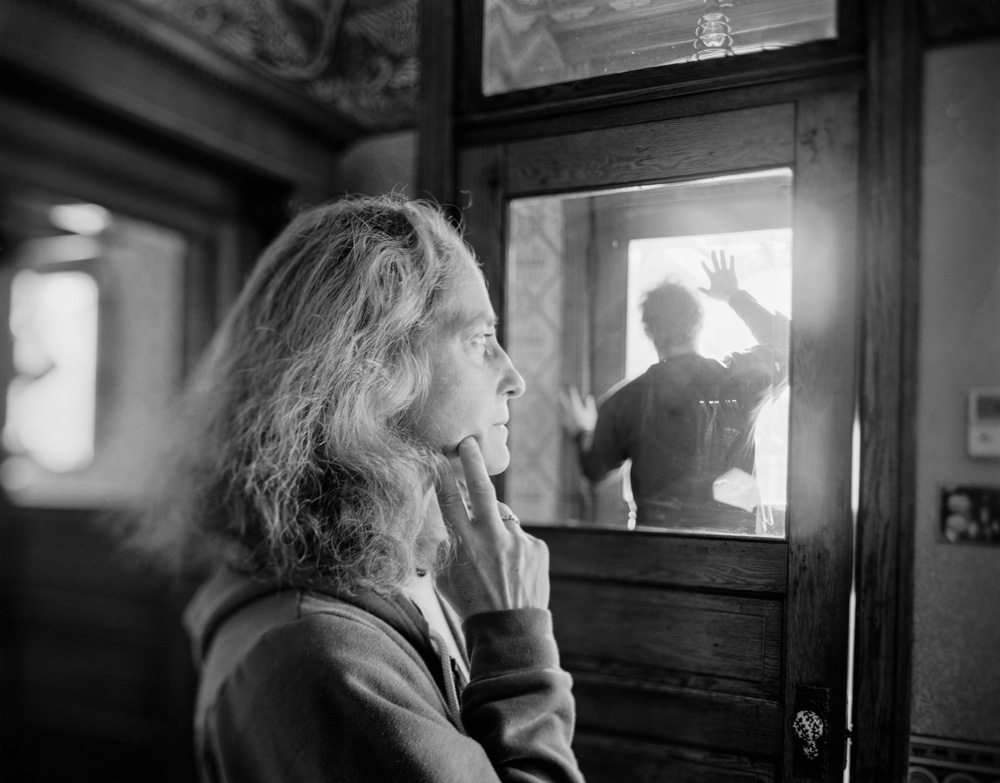
Laura Beth Reese is a Boston-based artist and curator. She was born in Iowa and raised in the Northeastern United States – sometimes in New Jersey and sometimes in Massachusetts. She completed her Bachelor of Arts in 2009 at Muhlenberg College in Allentown, PA and went on to earn her Master of Fine Arts in 2014 from the School of the Museum of Fine Arts, Boston. Reese’s work has been exhibited around the United States, most recently at the Griffin Museum of Photograph and the New Art Center, where she co-curated the recent exhibition I Want To Smell Your Hair. Laura Beth Reese uses photography as a catalyst for intimacy – taking pictures of others as a way of reaching out and connecting. Her projects are often autobiographical: she photographs people that occupy her life in one way or another. Reese photographs with a large format camera and color film.


Artist Statement: Home Study 

Home Study
is one component that addresses my status as an adopted child, focusing on my identity and the ways in which it has been shaped by my adopted family and the spaces in which I spent my childhood. The photographs were made in New Jersey, where I grew up and where my parents currently reside, and Utah, where my formally estranged sister lives. With many of the photographs, I worked in collaboration with both my mother and my sister, so that we could each have a hand in the process of representing the impact of adoption on our family. Our conversations about our family and the problems inherent in adoption strongly affected what I chose to photograph. This collaboration furthered the exploration of my relationships with my mother and my sister, so that the process of taking the photographs became as important as the photographs themselves. The images speak to the ways in which adoption has simultaneously aided in forming my strong relationships with certain family members and created conflict and unease in my relationships with others. Ultimately, the photographs speak to identity, family, and womanhood through the representation of my own personal narrative. They are the result of my constant search for my origins as well as an investigation into the ways that specific people and spaces have or have not shaped my identity.