Showing posts with label Mother. Show all posts

Monday, May 9, 2016

Caroline Waterman


Caroline Waterman is a photographer that explores memory, loss, place, and family. She is currently pursuing a BFA in Photography at UNCC. Caroline specializes in Silver Gelatin Lith and Platinum Palladium. Caroline grew up in Dublin, Ireland, moved to the United States in 1986, and lives in Charlotte, NC with her husband and three children. She is currently pursuing a BFA in Photography at UNCC. Caroline specializes in Silver Gelatin Lith and Platinum Palladium. Her work deals with the themes of memory and loss and she has drawn on her connections to family, heritage and place as inspiration. She has conducted workshops on Lith printing at UNCC, at Appalachian State University and at the Light Factory. Her work has been exhibited in venues such as the University Hilton Hotel in Concord, NC, UNCC and The Photo Place Gallery in Vermont. In 2017 Caroline will be exhibiting her work in a solo show at Through This Lens Gallery in Durham NC.


Artist Statement: Pieces and Transitions 

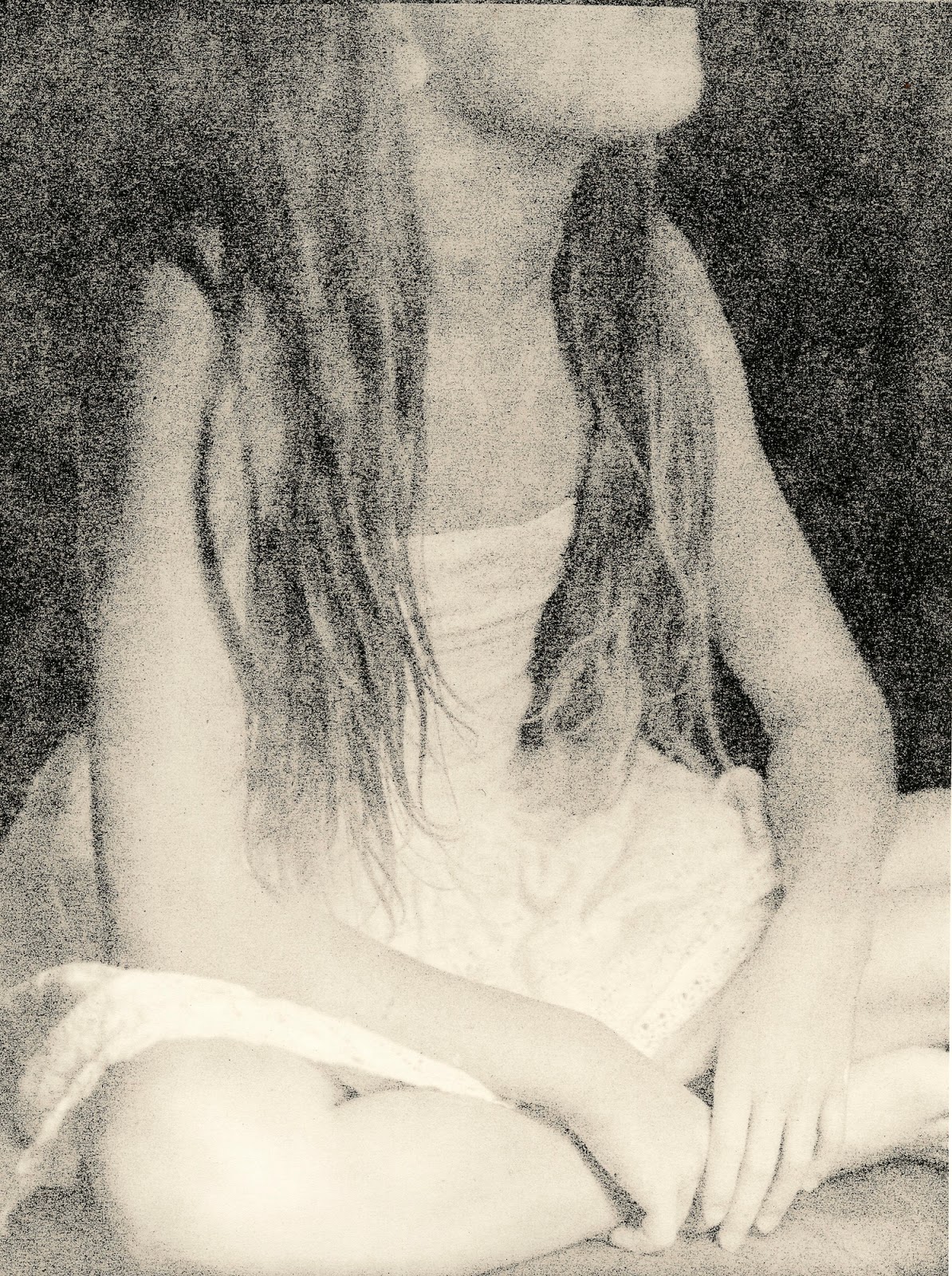
Pieces and Transitions documents my children and my surroundings in a series of photographs printed as Silver Gelatin Lith Prints. A memory is almost like a dream, at first strong and vivid, but becomes faded and blurry. People, places and things, once present in our lives, eventually are cast to our memory and will go in and out of focus with the passing of time. As I watch my children grow and change I am aware that they too are passing through my life, and their childhood will, as with my own childhood, become a memory. There is a sense that they are present but somehow not fully there, as though they have already begun to move away from me. All life is just passing through the world, but a presence is left behind.

The images depict my children as a presence, but this presence is at times unfocused and unclear. The use of the lith developer gives an old and grainy appearance, with soft white —underdeveloped highlights. It is a slow process, developing the image gradually, like an old memory coming back into focus.




Monday, April 11, 2016

Allyson Pinon


Allyson Pinon is a photographer based between Brooklyn and Baltimore. Her work explores human experience, understanding, and connotation within the context of contemporary society. She is interested in trying to better understand the diverse ways that people perceive and experience the world and, in turn, the similarities in experience that arise despite an immense multiplicity of viewpoints. Through these studies she attempts to search for commonalities and connections within largely universal human experiences like aging, loss, and memory. Her work has been exhibited internationally in Switzerland, Paris, Los Angeles, and other various cities throughput the United States. She is currently pursuing a B.F.A at the Maryland Institute College of Art.


Artist Statement: Losing Touch  

Seventeen years ago my mother had a stroke that left her paralyzed in all but her right arm. One of the first things she did after she left the hospital, capitalizing on the newfound numbness in her body, was get the tattoo she always wanted of the Rolling Stones logo over her heart. I’ve always been struck by my mom’s wit, perseverance, and brazen personality. After her stroke, my family thought the biggest struggle would be in trying to help my mother become physically adjusted to her new body. In reality, my mother’s biggest struggle is in convincing everyone around her that there is more to her than what her physical ability portrays. Losing Touch is an ongoing series that chronicles my mother’s life as she tries to navigate through a world that is not quite meant for her.

Disability has profoundly affected everyone in my mother’s sphere of influence. Even within that sphere, there are limits to each individual’s ability to engage and relate. It’s human nature to avoid what makes us upset or uncomfortable and attentions can shift quickly. My mother’s feelings of alienation and distance generate from the lack of opportunities to voice her perspective and bring it into the sphere of contemporary consciousness.

My mother has been disabled for most of my life and even I have only a vague understanding of how she understands the world around her. This realization spurred the inspiration for this body of work, as I continuously attempt to grasp the totality of my mother’s experiences in society. Getting through everyday activities can be a struggle but this constantly challenges her to create new avenues and opportunities to proceed through life. My mother’s computer has become one of her most invaluable possessions due to the sense of anonymity it provides and it’s access to all corners of the world. My mother uses her email as her preferred method of expression and communication, as it allows her to interact in precisely the same way as every other member of our society.

Throughout this, my mom is a fairly realistic person, with a darker wit, and she longs for understanding; not sympathy. This body of work is my attempt at navigating the duality between the way she is viewed and her own perspective.


Monday, November 2, 2015

Nicole Akstein


Nicole Akstein was born and raised in Atlanta, GA in 1985 to Brazilian parents. She received her BFA in Photography in 2007 from the School of Visual Arts in New York. She has freelanced for publications such as The Village Voice, Atlanta Magazine and Blender Magazine. Akstein's work has been exhibited in Georgia and New York. Her work explores ideas surrounding identity, gender, culture, and societal and social structures. Most images are shot with traditional black & white or color film, in 35mm and 120mm formats. In addition to photography, she has integrated video, light projection and mixed media installations into her work.

Akstein is currently based in Athens, GA, where she received her Masters of Art Education and Certificate in Nonprofit Management from the University of Georgia in 2014. She has taught art to students in pre-K through high school at various schools & community centers in Georgia, Brazil and India. She is the Arts Outreach Coordinator at the Steffen Thomas Museum of Art and art instructor at the Lyndon House Arts Center, while also working on projects and freelance opportunities.


Artist Statement: Mother, Mãe

Mother, Mãe, in its title alone, exposes its subject matter -- my mother. Our deep-seeded Brazilian roots pair the English term with the Portuguese translation, respectively. The work bears the weight of the overwhelming list of roles that women willingly and, often inadvertently, inhabit. The first role in which I abruptly came to know her, was none other than "mother," the center of my universe. As my link to the world, it is no surprise that I have been photographing her since I first picked up a camera. She is my most natural point of origin, stemming from the visceral. However, the works represent a woman, a state of mind, a spirit, and the passing of time. They are less biographical and more indicative towards notions of age, beauty, relationships, and the human condition.

Initially driven to convey the ambiguous nature of such roles, I became intrigued by the cultural forces that influence and shape the complex relationship women have with their mothers. In my experience, facing one's mother can be like facing a mirror, and these images can also be interpreted as self-portraits. I am confronting my beliefs, strength and femininity with hers. I am measuring these attributes to a lineage of women before and after her as well. I portray a woman who is trying to accept the body she inherited; one she passed on to me along with her image of herself. 


As our relationship evolved, the focus shifted towards exploring the relationship women have with themselves. Photographing her is an attempt to inhabit memories and re-create experiences, to transform them in order to somehow better understand their importance. The outcome consists of improvised, yet highly staged images, eluding any suggestion of a true reality and deliberately objectifying my mother. Images depicting the familiar landscape of a lake, swimming pool or bathtub are juxtaposed with scenes alluding to the bewilderment of death and rebirth.

The images weave a nonlinear narrative that invites and questions her reality. Among the dynamics taking place, beauty and fantasy are often undercut by loneliness, aging, and dissatisfaction. As an observer, I interpret her experiences in order to somehow justify my own. My mother wasn't always willing to play the role of a collaborative agent, and I don't blame her. The camera was an unwanted presence not only exposing herself to me, but exposing her to herself. The viewer is introduced to a woman through the eyes of her daughter, prompting one's own self-reflection.


Mother, Mãe is the result of a culmination of experiences, collaboration, conversations, arguments, and admiration for someone who informed my understanding of the world through her own. After years of sustained projections of her hopes and dreams placed upon me, one might infer that this body of work represents my response to living under a mother's thumb. However, it is my intention that this work empathize with her as a woman embracing her many roles, while confronting the notion that all may not be resolved in the end.


Monday, January 12, 2015

Heather Evans Smith

From the series, Seen Not Heard 

Heather Evans Smith is an award winning fine art and conceptual portrait photographer based in Winston-Salem, North Carolina. Her work captures both the everyday and the whimsical, telling stories of women and struggle, reality and the surreal. Smith’s work has been featured in solo and joint exhibitions, magazines, literary journals and online publications. Recently, she was chosen as a winner of Ron Howard’s Project Imaginat10n and one of the Critical Mass Top 50 of 2014.

Artist Statements


From the series, Seen Not Heard 

Seen Not Heard


For the past few years I have been creating images to express the emotions of motherhood. My daughter has never been included in those images. But as she has grown from a baby into a force of nature all her own, I was drawn to pull her into my world of conceptual photography and explore our relationship during a time when emotions of love, stress and confusion are high.

Seen Not Heard takes its title from the Old English adage “To Be Seen and Not Heard”, a term often thrown about in reference to the desired behavior of children. These images are silent, but they create a voluble visual narrative on the relationship between parent and child. They explore the cycles that are passed down through generations and the tension between keeping to what is known and forging a newer, and perhaps stronger, path. As strong as the close, forever bond between mother and daughter is, there also exists a distance inherent between two different individuals.

From the series, The Heart and The Heavy

The Heart and The Heavy

Life is full of stories – some deeply personal and specific, others universally relatable. My story is beautiful and complicated and bittersweet and hard. Life is just that way. So are photographs.

The birth of my daughter was life-changing, but not in the way I expected. Though there has been no greater joy for me, the responsibility of another life has proven to be at times a heavy load. Thinking about this in a literal sense, I imagined a heavy home on my shoulders, yet held tightly with love – a burden and a joy, a challenge and a reprieve. This became the first image in the series The Heart and the Heavy.

From there the stories evolved, just as my life has. The genesis of an image comes from moments of life, like a still from an old movie. Movement and pain and the simple joys of being alive are frozen in time – a study of fictional worlds based in reality. Compelled to shoot these stories, I am haunted for days and months until it is released in an image. Telling someone’s tale in a world not quite like our own.

Interview

From the series, Seen Not Heard 

Ashley Kauschinger: The Heart and The Heavy and Seen Not Heard both explore emotions associated with your daughter. How did these two bodies of work come about and develop? Did one grow out of the other? How are they connected and different?

Heather Evans Smith: At the end of 2011 an image kept entering my thoughts of a woman in a field, house strapped to her back, holding it tightly with love yet with so much weight. That vision became the first image in the series The Heart and The Heavy. My daughter at that time was two and I was experiencing some of the most powerful emotions that I had ever felt: love, connection, stress, heaviness. For the rest of the series I explored different emotions through images of myself and others. After two years of working on the series I was ready to approach something different. My first inclination was to take some of my previous The Heart and The Heavy ideas and try them with a child. I wanted to see how the image changed with a simple change of age. That idea morphed into using my daughter as a model and exploring the parent/child relationship through conceptual imagery.

From the series, Seen Not Heard 

AK: What brings you inspiration?

HES:
I am inspired by many things: a song lyric, a vintage item of clothing, an emotion, daily life, an old movie. I keep my mind open to new ideas and immediately jot them down. Sometimes I will shoot these images right away and at times it may take years for the timing to be right.

From the series, Seen Not Heard 

AK: How do you go about constructing narratives within your images?

HES:
Some ideas are specific at the time of the shoot and others tend to reveal multiple layers after the photograph has gone out into the world. I tend to think about the idea or emotion I want to express first and then how I can show that visually in the photograph. This can also happen in reverse order. When I stumbled upon a vintage hand-painted puppet theatre, I had no idea what I would use it for. That prop started the brainstorming that later became the image, The Roles We Play.

From the series, The Heart and The Heavy

AK: What technical approach do you take in your work? 

HES:
In The Heart and The Heavy series I wanted the images to look as real as possible, so everything is there at the time of the shoot. For the image Collide, instead of photoshopping the beach balls in later, I had 4 friends throwing balls at different heights in the background. Photoshop is definitely involved to a degree but all the details are originally in the frame for a realistic look. Most of the images are shot at 16mm for a cinematic feel.

For the series Seen Not Heard the approach is simpler. I shoot in the darker rooms of my house with open windows to create a more painterly light. Since the images are of my daughter, the series is more personal and shot closer with a 35mm prime lens.

From the series, The Heart and The Heavy

AK: How do you think about the balance of life and being an artist?

HES:
It is difficult being a full-time mom and artist. I don’t get to go out and shoot on a whim. Though limited, my time dedicated to my art is used wisely. Luckily with Seen Not Heard I am not searching for a certain sliver of time to shoot with a model or in a specific location, for my model and location is within my home. This isn’t always going to be the case, however, it has been nice to bring my daughter into my world of photography.

From the series, The Heart and The Heavy