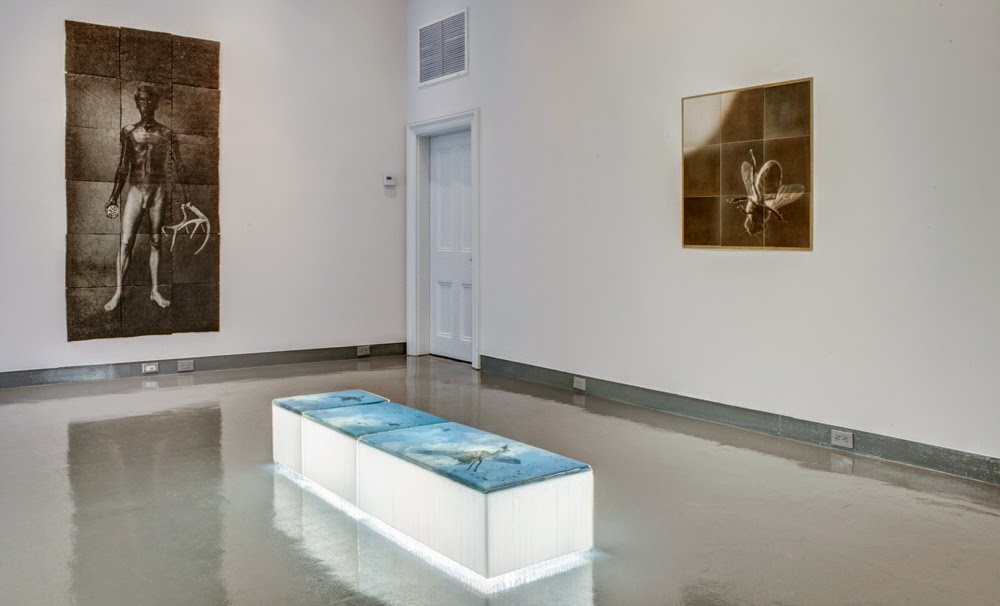
Showing posts with label Installation. Show all posts

Monday, February 8, 2016

Heather Wetzel


Heather F. Wetzel is an artist working in historic photographic processes, hand papermaking, and book arts. She is currently a Lecturer in the Art Department at The Ohio State University where she was the 2011-2012 Post MFA Fergus Family Fellow in Photography. She earned her Master of Arts & Humanities from Arcadia University in Glenside, Pennsylvania, and her Master of Fine Arts in Visual Studies from the Visual Studies Workshop in Rochester, New York. Prior to coming to The Ohio State University, she completed the University of Iowa Center for the Book Graduate Certificate in Book Arts Technologies in 2011. She is a 2012 Photolucida Critical Mass Finalist, as well as a semifinalist and The Print Center's Honorary Council Award of Excellence winner in The Print Center's 87th International Competition. More recently, she was a Review Santa Fe participant. Her work has been widely exhibited, and can be found at the Anzenberger Gallery in Vienna Austria, as well as in multiple collections.


Superstitions   

Artist Statement 

Time moves so fast. It seems there is less and less time for the slower things in life. Time to sit and reflect, time to remember, time to notice the little things. Analog ways are being replaced by faster technology. Photographic prints and books are being replaced by intangible, transient digital files made of zeros and ones - no texture, no smell, no weight. I prefer to work at a slower pace, with materials and process playing important roles in my making. My work is grounded in contemplation of life in the 21st Century, examining current social concerns, using a variety of materials and methods.

Squall


The quest for the best form for my ideas to inhabit finds me working in a variety of media, such as historic photographic processes, book structure and content, print, hand paper making, metal, and wood. I am equally concerned with the object and alternative methods of display, and with how my chosen materials support concept and content. I work predominantly with analogue processes, but am also interested in how these methods complement digital technologies, and work to seamlessly integrate digital processes as concepts dictate. My interest in these processes and materials all contribute to my concern in multi-media constructions and art as object.

Impractical Library 

Impractical Library 

Impractical Library 

Webster's New 20th Century 

Webster's New 20th Century 


Impractical Leisure 

Impractical Leisure 

Impractical Leisure 

Impractical Leisure 


Monday, October 26, 2015

Garrett Hansen


Garrett Hansen graduated from Grinnell College, where he studied economics and political science. He completed his MFA in photography at Indiana University and has taught at several universities in the United States and in Asia; he is now an Assistant Professor of Photography at the University of Kentucky. Garrett’s work deals primarily with issues of place and how we grow to know and understand the world around us. Garrett has had numerous solo and group exhibitions in the United States, Europe, Indonesia, and Japan.


Artist Statement: Hail

Roughly 40% of the population in the US owns a gun and there are enough guns - approximately 300 million - to arm nearly every man, woman, and child in the country.

At the core of the series is a desire to consider these facts and to create a set of images that speaks to their implications. Each of the images is created from individual bullet holes. While shooting is fundamentally a destructive act, by bringing these holes into the darkroom, enlarging them and then processing and printing the results, I am able to balance this destruction with creation. The viewer is presented with something that speaks to the sublime – they are both attractive and terrifying at the same time. In many ways this reflects our own opinions of guns in America, a country where the debate between rights and controls continues to rage.


Interview conducted by: Adam Neese 


Adam Neese: Can you tell us a little bit about how and why you began the Hail project?

Garrett Hansen: I had been thinking about doing a project that focused on guns in America for a number of years, but when I moved to Lexington to take a job at the University of Kentucky in the fall of 2013, I decided that I really wanted to focus on finding a way to think and talk about the issue. Part of it was that I had just returned from living abroad and that always helps me think more critically about our culture. Another part of it was that I was having a lot of conversations about guns with gun owners and I found that we largely agreed on issues of gun control. This put in stark relief how much the conversation has been dominated by a small but incredibly powerful segment of the population. I wanted to enter into that dialogue, or maybe more accurately, try to create a space for dialogue. That’s really at the heart of this work – an effort to create images that allow people on all sides of the debate to think about, rather than simply react to, this incredibly important problem that we have.


AN: In considering your images in the series Hail I am struck by the beauty created by abstracting the scale of the actual bullet holes. How did you arrive at the final form of the images? Can you tell us a little bit about that process as it relates to the rest of your working methodology?

GH: From the beginning I knew that I didn’t want to approach this issue through straight photography, but I didn’t necessarily have an idea of what the images should be. I knew I wanted to start with something that everyone could agree on and I thought that maybe the simple idea, and it sounds silly saying it, but I thought, “Bullets put holes in things. I’ll use that as a starting point.” I ran a few experiments in the darkroom by just punching holes in paper and there seemed to be promise in the approach. I then went to a local gun range and started to shoot some different materials to see what might work best. There were a lot of failed experiments – I was committed to the concept, but without a clear idea of what they should look like, I just had to keep trying different approaches. I wouldn’t say that each experiment contributed to the final result, but some aspects of the early failures definitely make their way into the final images. When I saw the first images that I made by solarizing orthographic film, I knew I was getting close. For me they go beyond the simple document or record; they reference the celestial and, in turn, the sublime. That was the goal – to create an experience for the viewer, not just provide them with a fact. I’m still developing the technique. I wouldn’t say I’ve mastered it, but at this point I’m really just refining it.

I suppose this is a variation on the way I typically work. Though most of my work is pretty straight, there is always a period of time at the beginning of a project where I am trying to figure out what the series should look like and what the best materials to use might be. I’m not one of those photographers who applies a single way of working to the world; I try to let the world influence me, which in turn directs me towards aesthetic and material choices.


AN: Most of the work on your website is representational and looks at the world “out there”. How did you arrive at this project where you are starting from nothing- a blank piece of paper- to make the work?

GH: What actually makes this project unique for me is that, in fact, I’m not starting with a blank slate. I have these shot-up pieces of paper and cardboard. I don’t know how I’m going to transform them, but I have the limitation of the materials themselves. That’s been a huge part of this – thinking about issues of transformation. How do you create something out of destruction? How closely are those two things linked in the first place? This might seem like an aside, but spending time in Indonesia, particularly Jakarta, helped me better understand how those things are linked. You’re in this huge sprawling city that is constantly being torn apart by nature. Shiva starts making a lot more sense.


AN: Who are some of your influences? Are there people looking at gun culture and the larger social/political issues around firearms with their art that you find inspirational?


GH: No, I’m not really looking for inspiration from other artists who are making work about guns and gun culture. That’s not to say that there aren’t some great artists who are working on this issue – including some photographers who I would be honored to show with. The photographers who really inspire me are old school folks - Lee Friedlander, Harry Callahan, and Yutaka Takanashi are people I return to constantly. They all seem like intensely curious people; each has proven to be highly experimental over their extremely long careers. They seem restless in terms of subject matter and approach – when I look at decades worth of images, I see them learning about the world and challenging themselves to find ways to use photography to share what they’ve found - that guides me as a photographer, and more importantly, as a person.


AN: It looks like you have been busy with 2 solo exhibitions in summer of 2015. How do you juggle all of the responsibilities that come with being a contemporary artist? Do you have any advice for aspiring artists and photographers?

GH: The one thing I would say is you have to make art for yourself above all else. I was lucky in many ways that I couldn’t study photography in college - we simply didn’t have any classes in it - but we had a student-run darkroom. I spent a huge amount of time there. I had fallen in love with photography completely at 18, but no one cared whether I did it or not. I had to find my own projects and educate myself on the history of photography. I made a lot of terrible pictures and I stuck with photographers who were easy to understand – Arbus and Friedlander made no sense to me when I was 20 – but I was slowly learning. I think a lot of students I see, at both the MFA and undergrad level, want someone to provide the education for them - read this, turn this project in on this date, make ‘x’ number of prints, etc. The students who I see who I know are going to be successful in whatever they choose to do with their photography are the ones who see the projects I give as challenges, not just assignments that need to get done. That’s the difference - they want to be there, there is nothing else they really want to be doing. I didn’t always live up to that ideal when I was getting my MFA, but I think it’s something to remember and strive for.

The other thing is that making art is hard. I’m not happy when I’m photographing - I’m focused. Sometimes I’m elated by the results, more often I’m deeply disappointed and frustrated, but I enjoy that period of focus. When the work finally comes together and I can stand back and look at it, I find I learn something new about the world. Your art should teach you, too. Oh, and don’t try to ‘brand’ yourself. That’s nonsense; you’re a human being.


Monday, March 23, 2015

Michelle Bablitz


Michelle Bablitz is an artist working predominately in the fields of photography and writing. Bablitz received her MFA degree in Imaging Arts & Sciences from Rochester Institute of Technology, and she has exhibited in both solo and group exhibitions across the United States. Her photographic work largely encompasses the motifs of memory, loss and self-actualization. Bablitz resides in Brooklyn, New York, where she actively writes, photographs, and runs the artist agency SAINT LUCY Represents.


Artist Statement: I could go with you.

The series I could go with you. is the fragmented narrative of an internal struggle following a traumatic event. The series’ narrator is unable to come to terms with memories that are overwhelmingly painful. While attempting to navigate daily life and regain a sense of normalcy, she is afflicted with repressions from the past emerging in her present-day world. The images obscure the possibilities of the narrator’s future with a permanent state of loss in her past, collapsing the confines of time and space. Her fragile retrospective sentiments, as well as the fractured chronology, are examined through glass etchings.


I could go with you. is an investigation into how text and image work together to communicate a story, while challenging the credibility of memory. In many ways a photograph is eternally fictional and unattainable; one can never look upon an image and revisit the same scene or moment that was tangible only for a fraction of a second to the image-maker. A photograph transports its viewer to a scene that can be infinitely reinterpreted, but never truly revisited. However, once text is written, or etched onto glass as it is in this series, it has factual and constant points of entry that conjure unique images and reference points to each reader/viewer. Text and image communicate a disjointed narrative that mirrors how memory and trauma function in the human psyche when combined in this series.


Monday, March 2, 2015

Lindsey Beal


Lindsey Beal is a photo-based artist in Providence, Rhode Island where she teaches at Rhode Island College. She has an M.F.A. in Photography from the University of Iowa and a Certificate in Book Arts at the University of Iowa’s Center for the Book. She is represented by Boston's Panopticon Gallery.

Her work combines historical & contemporary women’s lives and feminism with historical photographic processes. She is interested in the photograph as object and often includes sculpture, papermaking and artist books into her work.

Her work has been shown at national museums, galleries and universities and is included in various public & private collections. She recently earned an Honorable Mention for Center Forward 2014 at the Center for Fine Art Photography. She was a Finalist at the 87th Annual International Print Competition at The Print Center and received an Honorable Mention for emerging American photographers by the Magenta Foundation. Her work can be found at lindseybeal.net.


Artist Statement: Transmission

A bacterial sexually transmitted infection is a living, growing, mutating thing that exists within the human body. The act of transmission is often sexy; yet what is transmitted is menacing. The bacterial STIs before you (BV, Chlamydia, Trichomonas, Gonorrhea and Syphilis) can be silent for women and have little to no symptoms for men: they reveal themselves mainly through medical tests. Without testing, the cycle continues: without noticeable symptoms, no treatments are received; without treatments, the infections are unknowingly passed to others. Though mostly silent, all of these infections have potentially catastrophic side effects like pelvic inflammatory disease, joint disease, meningitis, sterility and fatal pregnancies. Although we should have eradicated these long ago, bacterial STIs continue to exist. Frighteningly, they are beginning to mutate and become drug resistant; gonorrhea specifically has outgrown our current treatments. Due to the recession, many non-profit clinics in which these STIs could be identified and treated have closed. What once seemed like a scary yet treatable nuisance or temporary problem is becoming a major public-health concern.

Transmission’s images are created by using open-source imagery from the Center for Disease Control. The images were altered, and then converted into digital negatives, which were used to print the cyanotypes. The prints are embedded in resin within Petri dishes. Each STI is represented in various images and whose information and prevention can be read about in the accompanying artist book.


Monday, January 5, 2015

Joli Livaudais


Anima (detail), eighteen 16" x 16" panels, total size of 96" x 48"
Aluminum, resin, and inkjet photographic print on Kozo paper


Joli Livaudais received her BA and MS in Experimental Psychology from the University of Texas at Arlington before establishing herself as a freelance commercial photographer in Dallas, Texas. Livaudais received her MFA from Louisiana Tech University in 2013, and is currently an Assistant Professor at The University of Arkansas at Little Rock. Her fine art incorporates her interest in psychology and explores the relationships between people and the constructs we use to interpret the world around us, and has been exhibited nationwide.

Animus (detail), eighteen 16" x 16" panels, total size of 96" x 48"
Aluminum, resin, and inkjet photographic print on Kozo paper


Artist Statement: Dreams and Replies

My artwork is an expression of my search for insight. The photographic compositions are inspired by my unconscious mind, through journaled dreams and free writing. They are my meditations on a universe and existence that is exquisitely beautiful, perfectly synchronized, and uncompromisingly merciless. I find that my carefully weighed conclusions about the human condition challenge me more than they provide any meaningful sense of safety, comfort, or promise of a happy ending. To exist is to struggle. In my artwork, this translates as an attention to process and labor-intensive practice. The accumulation of layers, fragmentation, deterioration, and replication are natural processes that are integral to the work and the meditation of creating it. Although the nature of the work lends it a timeless quality, I choose to use contemporary and experimentally combined materials including resin, photographic ink jet prints, aluminum foil and electrical circuits. The concepts I am exploring are primal, but my interpretation and understanding of them is anchored in today.

Observing Jonathan (1), 24" x 24" x 7"
Plexiglass, resin, photographic prints on film, and electrical wiring with lighting


Tarot XXI, 36"x36"
Gum Bichromate photographic print on brass plate

The Womb, 30" x 30" x 3"
Epoxy resin and inkjet photographs on kozo paper
The Womb (detail)
Core Sample, 14" long, 3" diameter
Resin, gold leaf, charcoal, bird skill, dye, photographic prints on kobo paper
All That I Love is comprised of over 1600 origami beetles (Installation below)
Aluminum, resin, and photographic prints on kozo paper

The Mother, Exhumed, 42"x16"x12"
Epoxy resin and inject photographs on kobo paper

The Mother, Exhumed (detail)

Installation view of Dreams and Replies, Martine Chaisson Gallery, New Orleans, LA

Installation view (2) of Dreams and Replies, Martine Chaisson Gallery, New Orleans, LA
Installation view (3) of Dreams and Replies, Martine Chaisson Gallery, New Orleans, LA