Showing posts with label Nature. Show all posts

Monday, April 25, 2016

Ryan Parra


Ryan Parra is a photography based artist with a primary focus on edible, medicinal, and psychoactive plants growing in the Tempe/Phoenix valley. He earned his BFA from the University of Oregon in 2012, and MFA at Arizona State University in 2016.


Artist Statement: Vivarium

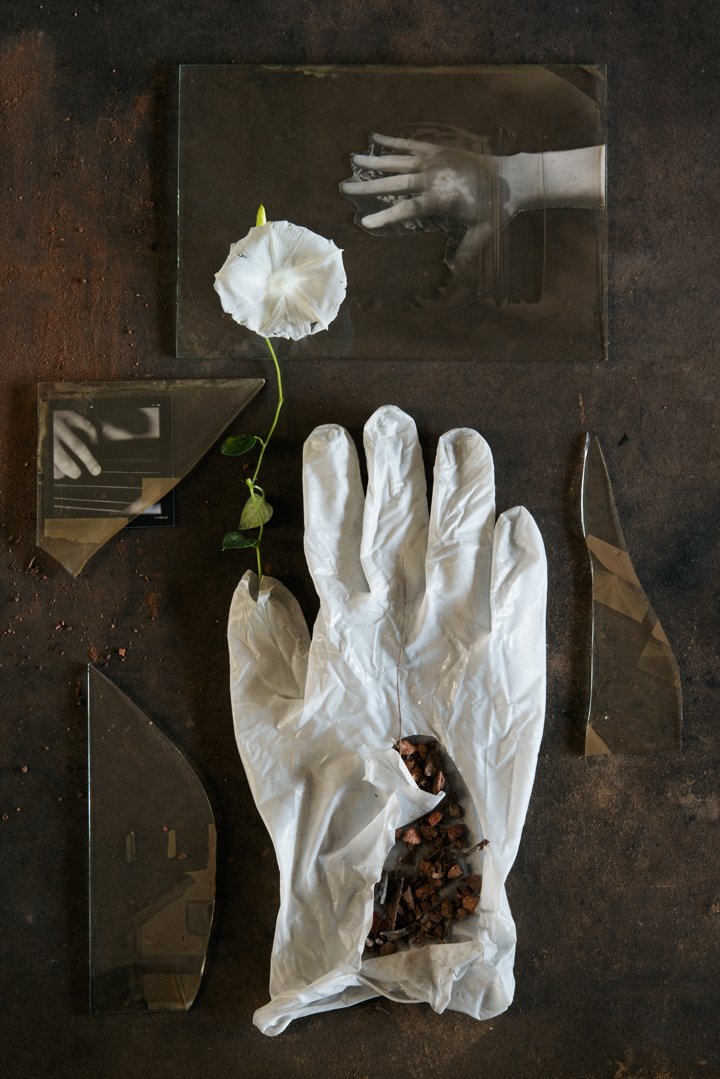
As pharmacology continues to advance, I believe it is important to have a sophisticated understanding of the plants from where it derived and knowledge of their traditional uses. My work is influenced by the rich history and current practices of ethno-botany (such as traditional shamanic practices), the history of still life paintings and plant illustrations, the exploration of plants as a system of knowledge, and the organization of agriculture for the purpose of sustaining the masses.

Urban areas continue to thrive and expand at a rapid rate, resulting in negative effects in biodiversity throughout the lands around them. As scientists are seeing a decline in biodiversity in wilderness areas, they are often finding the opposite trend in highly populated urban areas. This rise and fall of biodiversity is one of many reasons for my interest in still lifes of edible, medicinal, and psychoactive plants growing in the Tempe/Phoenix valley, as well as my focus on plants out in their natural environment. With this in mind, I hope to shed light on the rich variety and the importance of plants growing near and far from our homes. By incorporating styles from still life paintings throughout art history while also including descriptions of each plant's traditional uses, I want to remind viewers of the role plants have played in the exploration of knowledge and well being for thousands of years.

The title, Vivarium, reflects this interest in our unique relationship with nature, and sets the theme of curiosity, containment, and control. Vivarium, meaning place of life, is an enclosed space with plants or animals for observation or research purposes. For me, this act of concealing fragments of nature expresses a sense of power one has over something, much like science with nature, while also expressing great affection and love towards that same thing. It is in this binary friction that fundamental characteristics at the root of our own nature are revealed, as are issues evident in the modern perspective of the natural world.


Monday, March 30, 2015

Christa Bowden


Christa Bowden was born and raised in Atlanta, Georgia. She earned her MFA in photography from the University of Georgia and a BA in photography and film from Tulane University. She is an Associate Professor of Art at Washington & Lee University, where she started the program in photography in 2006. Her work explores the use of a flatbed scanner as a camera, as well as alternative photographic processes and the integration of encaustic and photography. She lives and makes work in Lexington, Virginia.


Artist Statement: Roots and Nests

Three years prior to the inception of this project, I moved with my husband and young son from urban Atlanta, Georgia to the tiny, rural town of Lexington, Virginia. This move refocused our world to be almost entirely centered around our small band of three, and building our home far away from our extended family and friends.

Like many in our area, I began planting a vegetable garden in the summer. With this came the task of many hours spent pulling weeds. This was usually a meditative activity for me, requiring physical rather than mental effort, and therefore freeing my mind to ponder other things. At one point during this seemingly endless job, I paused to evaluate the root structure of a weed that I had just pulled. I was suddenly amazed at the complicated, vein-like system that delivered sustenance to the plant. With our recent relocation in mind, I began to think of roots in a larger sense, as a metaphor for family and home. I started to explore other visual symbols of these ideas. Nests, as well as more subtle metaphors such as twisted muscadine vines and cocoon-like leaf fragments, became a part of the project. A second son joined our family, and as we continued to establish our roots and build our nest, I continued to seek a visual way to express this process.


These images are constructed and photographed using a flatbed scanner as a camera. The prints are often broken up, and brought back together in diptychs, triptychs, and quadrants of panels. I am interested in how an organic line is broken by a geometric edge, then continued, as the viewer’s eye attempts to complete the image. The prints are also layered with encaustic wax. With this, I hope to create a sense of a protective layer around the ideas of family and home, almost like encased precious objects. I attribute this to the need to express my maternal instincts and desire to protect my family in a visual way. Finally, a number of the roots have carved marks in the wax, with blood red oil pigment rubbed into the line work. I hope that through this, the viewer can further connect the metaphorical representation of roots to the idea of family, as well as see the visual connection between blood vessels and root structures.


Monday, January 5, 2015

Joli Livaudais


Anima (detail), eighteen 16" x 16" panels, total size of 96" x 48"
Aluminum, resin, and inkjet photographic print on Kozo paper


Joli Livaudais received her BA and MS in Experimental Psychology from the University of Texas at Arlington before establishing herself as a freelance commercial photographer in Dallas, Texas. Livaudais received her MFA from Louisiana Tech University in 2013, and is currently an Assistant Professor at The University of Arkansas at Little Rock. Her fine art incorporates her interest in psychology and explores the relationships between people and the constructs we use to interpret the world around us, and has been exhibited nationwide.

Animus (detail), eighteen 16" x 16" panels, total size of 96" x 48"
Aluminum, resin, and inkjet photographic print on Kozo paper


Artist Statement: Dreams and Replies

My artwork is an expression of my search for insight. The photographic compositions are inspired by my unconscious mind, through journaled dreams and free writing. They are my meditations on a universe and existence that is exquisitely beautiful, perfectly synchronized, and uncompromisingly merciless. I find that my carefully weighed conclusions about the human condition challenge me more than they provide any meaningful sense of safety, comfort, or promise of a happy ending. To exist is to struggle. In my artwork, this translates as an attention to process and labor-intensive practice. The accumulation of layers, fragmentation, deterioration, and replication are natural processes that are integral to the work and the meditation of creating it. Although the nature of the work lends it a timeless quality, I choose to use contemporary and experimentally combined materials including resin, photographic ink jet prints, aluminum foil and electrical circuits. The concepts I am exploring are primal, but my interpretation and understanding of them is anchored in today.

Observing Jonathan (1), 24" x 24" x 7"
Plexiglass, resin, photographic prints on film, and electrical wiring with lighting


Tarot XXI, 36"x36"
Gum Bichromate photographic print on brass plate

The Womb, 30" x 30" x 3"
Epoxy resin and inkjet photographs on kozo paper
The Womb (detail)
Core Sample, 14" long, 3" diameter
Resin, gold leaf, charcoal, bird skill, dye, photographic prints on kobo paper
All That I Love is comprised of over 1600 origami beetles (Installation below)
Aluminum, resin, and photographic prints on kozo paper

The Mother, Exhumed, 42"x16"x12"
Epoxy resin and inject photographs on kobo paper

The Mother, Exhumed (detail)

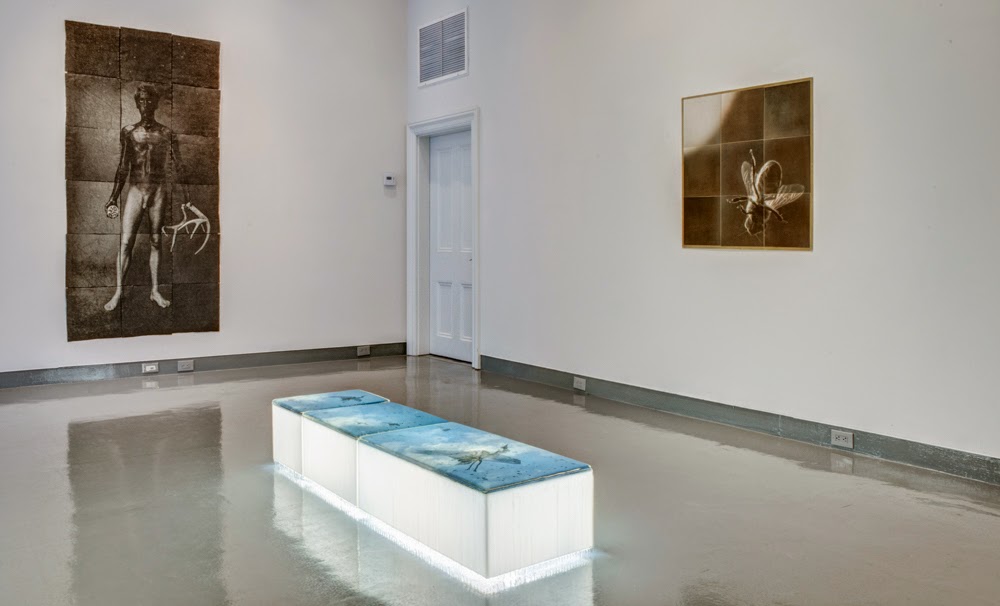
Installation view of Dreams and Replies, Martine Chaisson Gallery, New Orleans, LA

Installation view (2) of Dreams and Replies, Martine Chaisson Gallery, New Orleans, LA
Installation view (3) of Dreams and Replies, Martine Chaisson Gallery, New Orleans, LA


Monday, December 22, 2014

Chris Maliga


Chris Maliga is a photographer currently based in Boston, Massachusetts. His work has been featured in numerous exhibitions nationally, most recently at Piano Craft Gallery in Boston, Nave Gallery in Somerville, Massachusetts, and PhotoPlace Gallery in Middlebury, Vermont, among others. He serves as the Studio Manager for Photography at School of the Museum of Fine Arts, Boston. Maliga has also taught courses and workshops in photography throughout New England. He has printed black-and-white photographs for Barbara Bosworth and Mike Mandel. Maliga holds a BFA in Photography from Massachusetts College of Art and Design and an AA in Photography from the University of Maine at Augusta.


Artist Statement: Dominion

Nature has served as a refuge for me throughout my life, alluring an inquiring mind with its at once tranquil and ever-fluctuating state. For my photographs, I search for secluded locations that lack the tell-tale signs of human habitation. I am as much interested in witnessing the undisturbed passing of time in these spaces as I am in exploring my own desire to be a part of the movements within them. In these places, I am rendered aware of my own fragility. Through performative interactions with the terrain and the adverse elements, I find myself immersed in a sense of both freedom and vulnerability. There are cycles at work within the natural world that seem to us to be endless, but only because they have carried on for so much longer than we have existed. Night passes to day, snow turns to water, vegetation blooms and then shrivels. For the short time in which the shutter is open, my body is a part of these rituals. To me, these vanishing seconds are a welcome source of rejuvenation. By committing that moment in time to the silver of film and paper, it achieves a permanence that neither I nor the weathered ground will ever truly know.


Monday, November 24, 2014

Jaime Johnson


Jaime Johnson grew up in Mississippi where the sounds of wild animals outside her window became her daily melody. Jaime received her BFA from the University of Mississippi in Imaging Arts and her MFA in Photography from Louisiana Tech University. Johnson was named a finalist for the 2014 Clarence John Laughlin award and her work has been shown nationally. Her series Untamed recently won the Grand Prize in the Maine Media Workshops international contest Character: Portraits and Stories that Reveal the Human Condition.


Untamed chronicles the intimate relationship of a feral woman and her surrounding natural environment. She collects the bones, branches, and flora of her world and treads with the animals, both dead and living. The cyanotype process shifts focus from potentially colorful landscapes and figures to patterns, textures, and the relationships of forms within the images. Discovery—both psychological and physical— is present and reveals each of us, whether human or animal, is a part of a shared experience. Untamed ultimately reflects upon the forms, the impermanence, and the interconnectedness of nature’s life.