Showing posts with label Place. Show all posts

Monday, January 18, 2016

Millee Tibbs


Millee Tibbs’ work derives from her interest in photography’s ubiquity in contemporary culture and the tension between its truth-value and inherent manipulation of reality. Tibbs’ exhibition venues include the Blue Sky Gallery – Oregon Center for the Photographic Arts, Portland, OR; the Museum of Photographic Arts, San Diego, CA; Mary Ryan Gallery, NYC, NY; David Weinberg Photography, Chicago, IL; the DeCordova Sculpture Park and Museum, Licoln, MA; Brown University, Providence, RI; and Notre Dame University, IN. Her work has been published by the Humble Arts Foundation, Blue Sky Gallery, and Afterimage: The Journal of Media Arts and Cultural Criticism. Tibbs’ work is in the permanent collections of the RISD Museum, the Portland Art Museum, and Fidelity Investments, and is also held in the Midwestern Photography Project at the Museum of Contemporary Photography, Chicago, and in the Pierogi 2000, Brooklyn flat file. She has been awarded residencies at the MacDowell Colony, VCCA, the Wurlitzer Foundation, Jentel, the Santa Fe Art Institute, and LPEP, Buenos Aires, Argentina. Tibbs grew up in Alabama, completed an MFA at RISD in 2007, and is an assistant professor of photography at Wayne State University.


Artist Statement: Mountains + Valleys 

I am interested in surfaces and their relationship to what lies beneath – the discrepancy between what we see and what we know. I am drawn to photography because of its ubiquitous presence in our culture and its duplicitous existence as both an indexical representation of reality and a subjective construction of it. It is a slippery medium that easily shifts from scientific documentation of a moment in time to a subjective construction of reality. I am interested in the space where these qualities contradict each other and coexist simultaneously.


My current work focuses on the dichotomy between “landscape” (an intangible vista) and “place” (a tactile, inhabitable space). I am interested in the aesthetic framing of the landscape of the American West that perpetuates expansionist ideologies through the representation of unoccupied, and seemingly unoccupiable spaces. By disrupting the photographic image through physical interventions (folding, cutting, and sewing), my work responds to the limitations of the photographic illusion. Each image holds the tension between the expansive, inaccessible vista and the intimate, tactile experience of the photo-object.


Monday, February 9, 2015

Laura Beth Reese


Laura Beth Reese is a Boston-based artist and curator. She was born in Iowa and raised in the Northeastern United States – sometimes in New Jersey and sometimes in Massachusetts. She completed her Bachelor of Arts in 2009 at Muhlenberg College in Allentown, PA and went on to earn her Master of Fine Arts in 2014 from the School of the Museum of Fine Arts, Boston. Reese’s work has been exhibited around the United States, most recently at the Griffin Museum of Photograph and the New Art Center, where she co-curated the recent exhibition I Want To Smell Your Hair. Laura Beth Reese uses photography as a catalyst for intimacy – taking pictures of others as a way of reaching out and connecting. Her projects are often autobiographical: she photographs people that occupy her life in one way or another. Reese photographs with a large format camera and color film.


Artist Statement: Home Study 

Home Study
is one component that addresses my status as an adopted child, focusing on my identity and the ways in which it has been shaped by my adopted family and the spaces in which I spent my childhood. The photographs were made in New Jersey, where I grew up and where my parents currently reside, and Utah, where my formally estranged sister lives. With many of the photographs, I worked in collaboration with both my mother and my sister, so that we could each have a hand in the process of representing the impact of adoption on our family. Our conversations about our family and the problems inherent in adoption strongly affected what I chose to photograph. This collaboration furthered the exploration of my relationships with my mother and my sister, so that the process of taking the photographs became as important as the photographs themselves. The images speak to the ways in which adoption has simultaneously aided in forming my strong relationships with certain family members and created conflict and unease in my relationships with others. Ultimately, the photographs speak to identity, family, and womanhood through the representation of my own personal narrative. They are the result of my constant search for my origins as well as an investigation into the ways that specific people and spaces have or have not shaped my identity.


Tuesday, December 16, 2014

Sarah Pfohl


An artist and teacher, Sarah Pfohl lives and works in Mount Pleasant, MI, where she teaches at Central Michigan University. Sarah earned an MFA in Art Photography from Syracuse University in 2014.


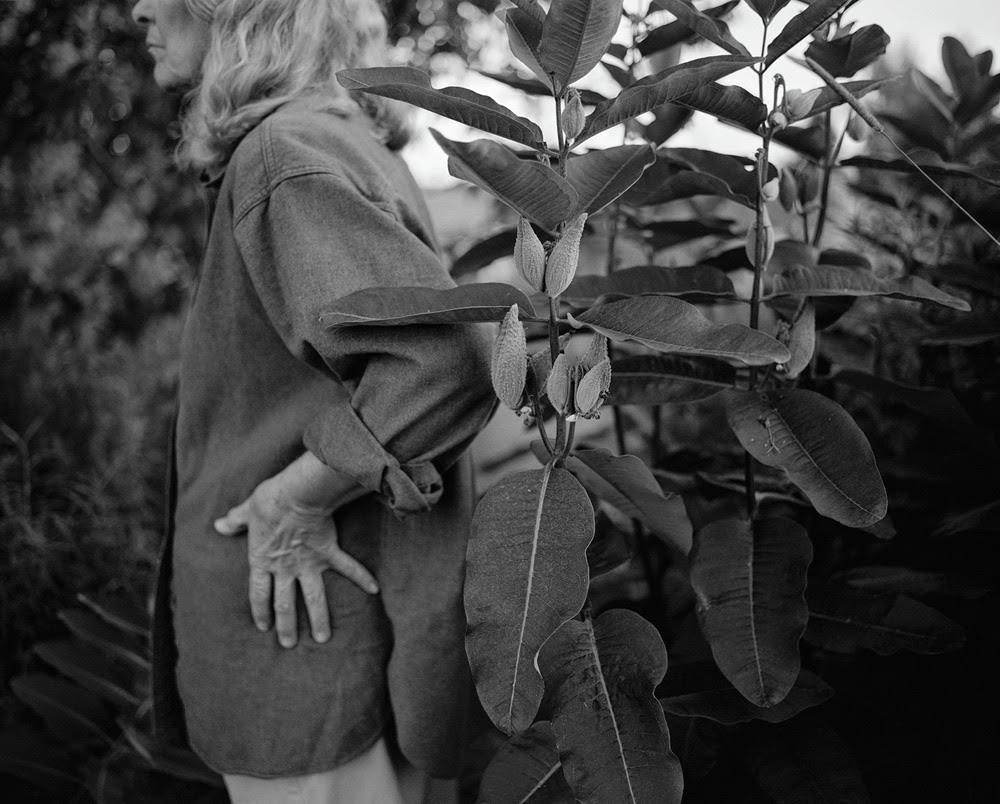
Artist Statement: The forest rests also in you

My mother knows particular things about the place where we both grew up. Between which trees the sun rises in a specific season. What grows here, what might. How to break open a piece of shale against another rock. That once, there was an ocean here and later a glacier. That the wind peels away at the roof and other corners, as a tree root the width of her arm emerges into the cellar.

Human life relies on the natural resources housed, cultivated, and stewarded in rural areas for daily survival. As a result, the rural is constantly present, yet not always acknowledged, in lives lived fully separate from it.

Since 1960 my family has lived in one place, on 26 acres of rural land in southern Madison County, New York. The distinct local knowledge my mother has accumulated over the course of her life here and the way she has learned to interact with the land represent an understanding of the rural founded in the intricate, interdependent complexity located there. Through a series of landscape photographs and portraits of my mother made at home, I represent the land as an extension of the human body and as a distinct and living presence to make visible the crucial role the rural plays in all people’s daily life.


From my mother

Sarah asked me to write about this. I don’t like being photographed but I was happy to help my kid. It was good to spend time with her. I’m old and wrinkled so its funny she wanted to take pictures of me. She said she likes that I am old. I always had to wear the same things, like a uniform and could never smile. Maybe it is useful to know that while Sarah photographed me for this, my mother, her grandmother, died. Our small family became generationally smaller. It seems important to mention.

I’m not sure what she was looking for. We stayed mostly at home in the woods I know well. She took pictures of me and the plants. We spent a lot of time outside. Often it was hot or cold or buggy and she would ask me to stick my face in a tree or stop smiling or to relax my shoulders. I think we got along well. Sometimes making pictures didn’t go well and I felt bad because a good model should help make good pictures but Sarah would say it was just a bad day and not my fault. Sometimes she would come home but the rain or the wind would keep up inside. She wouldn’t let me photograph her.

I like some of the pictures we made. I want them to be at my funeral.


Monday, August 4, 2014

Rachel Boillot


Rachel Boillot (b. 1987) grew up in New York and Singapore. Her undergraduate coursework was completed at Tufts University and The School of the Museum of Fine Arts. She spent the following two years working as a photographic archivist for the Boston Housing Authority. Before returning to graduate school, she taught photography at My Life, My Choice, helping victims of sexual exploitation tell their own stories.

Rachel graduated from Duke University’s MFA|EDA program this past May. Post Script was her thesis work. The project is available as a limited edition photobook and also marked her first solo exhibition at the Cassilhaus Gallery. 

All of Rachel’s photographic work explores the American home and socio-cultural landscape. Other projects have looked at her own home, foreclosed homes, public housing developments, and former mining boomtowns.

As the recipient of a post-graduate fellowship, she will continue to photograph in North Carolina and Tennessee this upcoming year.


Post Script 

In 2011, the United States Postal Service announced 3,653 rural post offices would close. A disproportionate number of the condemned are located in the South. Several thousand locations have since been added to this list of erasure as the Postal Service struggles to cement its foothold in an increasingly digitized world. The fate of the rural post office remains unclear. 

Growing up in America, I scarcely thought about the post office. Its ubiquity in the American landscape rendered it nearly invisible to me. In Post Script, I explore how the post office embodies the identity of place.

The post office serves as town center in rural communities. Often acting as a town’s sole address, this location embodies the numerical identity of place. Without its presence in the landscape, a ZIP code is lost. Yet residents remain anchored in place. In spite of post office departure or a vanished code, the home stands. Attachment to land lingers, rooted deeper than digits. 

I was initially intrigued by the dilemma of the Postal Service because of the parallel to my own field. Like the letter, the analog photograph seems threatened at present. Though photography flourishes, the transition from analog to digital has rendered aspects of my own practice obsolete—even entirely extinct. As remains of the analog world coexist with the emergent digital technology, this moment of change begs consideration.

Upon reflection, I realized the similarity between photographs and letters. From the moment the envelope is sealed, or the shutter clicked, both objects bring messages from the past. As the object arrives, it brings this past into our presence, whispering across distance. As each takes flight, the sender relinquishes all control. Their very message relies upon the grasping interpretations of a recipient. Both are full of gaps, filled with mystery and the struggle to communicate across time and space.

This is a work about post offices. It is also a work about place—in this case, many different places in the rural South—but more importantly, the very notion of place. How we name it and if we can claim it.