Showing posts with label Collaboration. Show all posts

Monday, April 21, 2014

Triple Feature ||| FOUND

Garth Amundson & Pierre Gour


Amundson and Gour have artistically collaborated for the last 29 years. Their work explores the perceptions and politics surrounding the domestic sphere and identity. They use collage and photo-scanning techniques to speak metaphorically about social construction. Some of their work is literal collaboration, and at other times, they serve one another in a support role. They are a team who insist on producing challenging work that provokes a response.


Amundson holds an MFA from Syracuse University and Gour from the University of New Mexico. They both currently teach at Western Washington University in the Department of Art. Their work has been exhibited in South Korea, Spain, Sweden, and throughout North America. They have completed several residency programs, both independently and collaboratively; Sculpture Space in NY, Cimelice Castle near Prague, Fundación Valparaíso in Spain, Lademoen in Norway, and a Fulbright in Mexico. Recently they received a Rockefeller Foundation Residency Award and will be at The Bellagio Center in summer 2014.

Learn more about Garth&Pierre here

Garth is also coordinating the upcoming SPE-Northwest Regional Conference at WWU in Bellingham, WA on October 10, 11, &12, 2014.. The title for the conference is TRANSFIXED|TRANSMEDIA which is designed to address new definitions of photography.

The committee is looking for applications that push the boundaries of image making, image consumption, theory, and discourse in all contexts. The conference will highlight both Rodney Graham, as the keynote speaker, and Jess T. Dugan, as featured speaker.

Applications are open to virtually everything! Please pass the submission forms on to your friends and colleagues. The deadline is April 30, 2014.

https://www.spenational.org/resources/calls-for-entry/spenw-2014-conference-call-for-proposals

Project Statement 

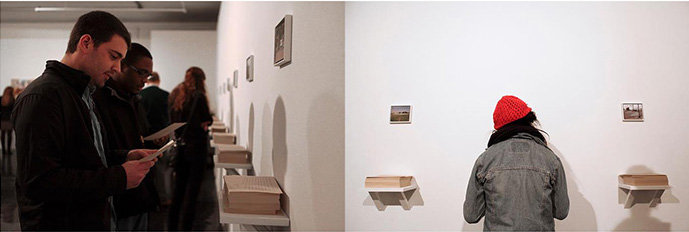
The work itself is in keeping with the rest of our experiments with appropriation of vintage photography. In this context, we have paired turn-of-the-century studio portraits of two men into single images. Referencing the complexities of queer identity and the often convoluted morphing of two beings into a single relationship, these "couples" awkwardly hold space in an absurd and monstrous fashion. As if they were suspended trophies, the couples hang together in a strange and whimsical groupings.


Nick Schietromo


Nick Schietromo is a fine art photographer, residing in the Boston area. His work deals with various aspects of domesticity. He is a recent graduate from the New England Institute of Art and currently works as the Assistant to the Director of Gallery Kayafas in Boston, a framer at Panopticon Imaging in Rockland and an intern at the Nave Gallery in Somerville. Recent exhibitions and publications of his work include a solo show at The Nave Annex Gallery, the Flash Forward Festival 2013: Undergraduate Photography Now, Aint-Bad Magazine and Stampsy.

Project Statement 

While rummaging through shoeboxes and hand woven baskets at yard sales, I search for memories of domestic pasts via the anonymous photograph. These prized possessions, once intended to be stuck to refrigerators, thumbed through in albums with intimacy and care, are now displayed for all to pillage through in estate sales. Now void from their original context and stripped of identity, these objects exist with bent corners, faded coloring and patinas offering endless narratives. The more antique images I discover, I wonder what photographs from present day would look like in the future. Will we treat the digital decay of a photograph as fondly as a well-worn print corner or a faded and stained image in a frame? Through digital manipulation via binary code corruption of these found vernacular photographs, I am reassigning image value within a social archive. The new image creates a questioning of the societal shift from storing and exchanging analogue images to the storing and sharing of the digital files, and ones intra/interpersonal relationship to this imagery.


Monday, April 7, 2014

Lori Nix

Botanic Garden, 2008 


Lori Nix was born in the late 1960’s and raised in the American Midwest. Her early exposure to the destructive powers of Mother Nature and Hollywood dystopian stories fueled her young imagination and has led her to where she is today. For the last 20+ years she has constructed small scale dioramas and photographed them. Beginning with retelling the tall tales of her youth in her Accidentally Kansas series, she has progressed to imagining urban scenes of the apocalypse. Her last series, The City, spanned nine years and imagined a future mysteriously devoid of mankind. Intensely detailed and rich in color, her photos offer up a possible future for modern society. Nix received her B.A. in ceramics from Truman State and studied photography at Ohio University. Upon relocating to New York fifteen years ago she participated in the AIM Program at the Bronx Museum. She is a two time recipient of a NYFA grant and currently is on their artist advisory committee. She routinely mentors young artists and lectures at colleges and universities nationwide. Nix has gallery representation in NYC, Chicago, Boston, Seattle, Toronto, Italy and Germany. Her work has been shown in the Museum of Art and Design in NYC, The Toledo Museum of Art in Ohio, and The Bruce Museum in Greenwich, Connecticut. She also is a partner in a digital printing studio in New York City, JAM Editions Inc.

Nix is also involved in a video collective called Four Story Tree House, four people who come together to tell epic stories through miniatures. She also owns a digital printing company, specializing in printing for other artists.

Interview conducted with Lori Nix by Ashley Kauschinger and Sheryl David


Light Leaked: Your images are beautifully perplexing, and have an acute attention to detail in the creation and photographing of each set. Can you talk about your process from conception to final product?

Lori Nix: First and foremost, there are two of us creating these scenes. I work with my partner Kathleen, and we've been collaborating for almost fifteen years now. With the next project, I will be adding her name to the work. Think of how Cristo became Cristo and Jean Claude. I usually get my inspiration during my morning commute to my day job. There is something about being half asleep on a subway, slowly rocking back and fourth that puts me into a half lucid, half asleep frame of mind. This is when the images come to me. I keep all of my potential ideas on my phone. If I still like them in two years or so, I'll consider making it into a diorama. When I get excited about an idea, I then have to sell it to Kathleen, because it will become our reality for the next seven months, the approximate time it will take us to construct the diorama. Once we settle on the image, I'll start researching spaces and object on the internet, through books, or visiting similar spaces. I then sketch out my ideas, usually over a nice breakfast out, and then we start gathering the materials we will need. The work is divvied up according to our strengths. I take care of the structure and architecture of the space, ie, the walls, floors, ceiling, furniture, fixtures, and Kathleen will work on the small details like sculpting animals, casting objects in plastic and plaster, creating tools, and any sort of carving details. I figure out the color palette and she does the aging and staining of the space. When all the details are in place, I carefully light the scene and start shooting sheets of 8x10 film. I hopefully can capture the final image within a week, but sometimes it may take up to two weeks to tweak the lighting and create the final image I want.

Map Room, 2010

LL: What goes through your mind while you are creating your work? What atmosphere do you create for yourself?

LN: Believe it or not, I go through a lot of doubt while creating the work. I'm constantly asking myself if I can pull off the particular scene I'm working on, is it worth seven months of time and energy, if it's worthy of being on a wall. When Kathleen and I are nearing the end, putting the last few details in place, we're usually depressed because it never seems like we're ever going to finish the diorama. There is always more and more detail to add. It never ends. We try to create a comfortable working atmosphere, so in the evenings, the tv will be on, and on the weekends we listen to the radio non-stop. During the summer, we listen to a lot of men's golf on the television (the announcers are so nice and talk very quietly), or we'll have a baseball game on the radio. We burn incense because I believe a good smelling studio helps alleviate the drudgery of the work.


LL: You work several jobs, while also maintaining your art practice. How do you balance your work and life? What advice do you have for new photographers?

LN: Both Kathleen and I work non-stop. We work 40+ hours a week at our day jobs. We pick up commercial work when it's economically beneficial, and we work in the studio at nights and on the weekends. Our lives are rather boring, but it's what we do. We have a running joke between ourselves "fun is relative". We do this because without the day jobs, we wouldn't have enough money to create the artwork. The day jobs pay for the art supplies and the art work pays the rent. But…we’re also most happy when we busy in the studio, either working towards a show deadline, or working on a video with a very specific shoot date. We kind of thrive under stress. Advice for new photographers? Don’t give up. It may take a while to complete a project, or gain interest in your project once you introduce it to the world. Be patient, but be persistent. And this is the secret to success. It takes time for possibilities and opportunities to come to fruition.


Book images from iocolor.com/city-portfolio/

LL: Your series, The City, has recently been published by Decode books. Can you talk about what the publishing process was like for you?

LN: I met John Jenkins, the publisher over a decade ago. We were standing next to one another at a portfolio review event in Portland; back when Photo Lucida was called Photo Americas. At these portfolio events, everyone talks to everybody. We struck up a conversation and shared our portfolios with each other. John and I kept running into each other over the next couple of years, always trying to catch up on what each of us was up too. I had been working on The City series for ten years and was starting to think seriously about a book. It was a stroke of luck that I ran into John in Miami and through casual conversation I told him I was looking for a book opportunity, and he was looking for his next artist to publish. I only had a few specific requests for the book. I wanted it to be a formal photography book, nothing too design-y, and I didn’t want any of the photographs to go across the gutter. I am not a book designer, nor do I pretend to be, so I let John take the reigns with the design. He fleshed out the book with detail shots and close ups that really pull the viewer into the scenes. I love his design; I love the size of the book. I think he really brought out the best in my images.

The City can be purchased here: www.decodebooks.com/nix.html


Tuesday, November 5, 2013

Ariya Martin


Ariya Martin received her Masters of Fine Arts in Photography from the Rochester Institute of Technology. Born in Rochester, NY she has worked at significant photographic institutions such as the George Eastman House and Kodak. A resident of New Orleans since 2006 she co-founded One Bird, a nonprofit that blends social work and art. The pilot program, The New Orleans Kid Camera Project, began in the wake of Hurricane Katrina. It was created to address the psychological and emotional impact of displacement on children returning home to New Orleans. Since One Bird’s inception, Ariya has conducted photography workshops for Tibetan refugees in India and for youth in Haiti. She also serves as full time faculty in the art department at The University of New Orleans. Her work investigates personal narrative and everyday moments in an effort to express the delicate balance inherent in living. Recent photographic work from her series Everything Nothing Everything was given honorable mention in the critical journal, The Photo Review, and her various works in photography, video and installation have been exhibited nationally.

View more of Ariya's work here

Photograph by Southerly Gold collective 

Ashley Kauschinger: Can you talk about your female photography collective, Southerly Gold? What brought the four of you together? What are your goals? What are your thoughts on collaboration?

Ariya Martin: The idea started while talking to photographer and friend, Aubrey Edwards. It was actually Aubrey who connected all of us- I didn’t know Elena or Akasha before. I think it was while we were discussing our frustration with the fact that there weren’t any galleries dedicated to contemporary photography, and also from the desire to create a supportive community of like-minded women. So we met over a few drinks and started brainstorming. It fell into place really organically. We all get along really well and we have recently embarked on a collaborative photography project about Louisiana. Aside from my own art making I have found collaborating to be extremely rewarding. It's actually becoming more difficult to work on my own the more collaborative work I do. I enjoy the dialogue, the sharing of ideas and the creative energy that gets generated.

Ariya teaching in Haiti with One Bird 

AK: You are also the Co-Director of The New Orleans Kid Camera Project. What an inspiring project! Can you discuss how it came about and your mission?

AM: The New Orleans Kid Camera Project began after Hurricane Katrina. Cat Malovic and Joanna Rosenthal were finishing their Master of Social Work degrees at Tulane and had been volunteering in the ninth ward where they met a family (the first to return) with four children and a newborn. After Katrina, schools were closed, many neighbors hadn’t returned, and so the kids had nothing to do. My friend and I, who are both photographers and had been teaching kids at a community darkroom in Rochester, NY met Cat when we came down to volunteer rehabbing houses. After that initial meeting we knew we wanted to come back so we raised money, got cameras donated and drove down to New Orleans a few months later. We found kids and started other groups by literally driving around and asking kids if they wanted to take pictures and do art projects. If they said yes we showed up and would continue to meet with them every week! Our focus was to work in areas of the city that had been historically neglected as well as quite obviously neglected after Katrina. The mission of our non profit, One Bird, that the New Orleans Kid Camera Project is a project of, is to teach our participants tangible skills that will assist them in sharing their stories and conveying their perspective, identity and culture. It is very important that we collaborate with their community, their families and take into account their cultural background (since we are usually outsiders). Our primary tools are photography and writing.

(collection 1) #1 

AK: Your work has a sense of being playful with everyday life. What motives you to create? Do you photograph spontaneously? What inspires you?

AM: My photographs are a combination of spontaneity and thoughtful inquiry. I don’t have a set plan, but I do usually have an idea before I start making pictures. Everyday, personal spaces and things I am going through in my daily life inspire me. By that, I mean small, intimate moments that we probably have all experienced. They feel so personal and yet they are completely universal as well. For example, the most recent body of work began in my grandfather’s house in Queens, NY. Shortly before his death, at the age of ninety-two, I went to visit him in the hospital. While there I began to notice small changes, signs of aging, and it became clear to me in a way that it hadn’t before, that even though the house still resembled very much the place of my childhood memories, it wouldn’t for much longer. So I began making pictures of the house as I knew it, and the house as experienced by my grandfather. There were the objects, not yet relics, of our family and my grandfather’s life. After his death I continued to go back and photograph as the house changed- as objects were removed and renovations were done in preparation to sell it. I was trying to capture, with my digital camera, the confounding effect of time virtually standing still, yet also leaving its mark. Which I think we can all relate to. This is basic stuff: living, aging, dying, being human.


AK: You use a broad range of media--from photography and video to sound and sculpture. Have you always been interested in combining media? Do you feel each media allows you to say something new? Has this given you more freedom to express?

AM: When I first started taking photography seriously in college the darkroom got me hooked. I probably spent the first four years focusing mostly on black and white photography- only showing color work occasionally. It wasn’t until I went to grad school that I started making videos and working in installation. It was like my world simultaneously opened up, but also collapsed. I had been focusing on one thing for so long and then all of a sudden, I wanted more than just photographs hanging on a wall--I wanted the experience to be more immersive. There’s more freedom in that, but By creating more possibilities you have more freedom, but you also have more choices and more decisions. The challenge is to know when to use still photography, video, sound and to when to incorporate them into a larger installation.

Teeny Tiny Tower #1
AK: You are involved in many projects. How do you balance this with creating your own work and life?

AM: Balancing everything is about prioritizing and about learning how to say no to opportunities when you have too much on your plate. I am not the best at time management, and I always stress to my college students that time management is one of the most important skills you can learn. As I get more involved and artistically fulfilled by collaborative projects I am spending more time on them and less on my individual work. The artist Janine Antoni did a piece where she learned how to walk a tight rope. What she said about this experience really resonates with me: "I started to notice that it wasn't that I was getting more balance but that I was getting more comfortable with being out of balance...."


Monday, April 15, 2013

Mark Strandquist


Mark Strandquist (Richmond, VA) strives to facilitate interactions that incorporate viewers as direct participants, features histories that are typically distorted or ignored, and challenges the form and function of public space.

His work has been featured in various institutions, film festivals, print and online magazines, and independent galleries. The project Write Home Soon was exhibited in the 2012-13 international showcase of Socially Engaged Art at the Art Museum of Americas, Washington, DC. The ongoing project, The People’s Library is part of the permanent collection at the Main Branch of the Richmond Public Library and will be presented by Strandquist at the 2013 Open Engagement Conference.


View more of Mark's work here 


Project Statement 

Some Other Places We've Missed is an ongoing project featuring collaborative practice, interactive installations, and workshops held in various jails and prisons. Functioning in multiple ways, the project uses photography as the catalyst for social engagement and strives to facilitate a humanistic window into the histories, realities, and desires of some of the 2.3 million incarcerated Americans.

At each workshop inmates are asked: “If you had a window in your cell, what place from your past would it look out to?” Participants provide a detailed memory from the chosen location, and describe how they would want the photograph composed. The locations are then photographed and an image is handed or mailed back to the incarcerated participants.

While the images facilitate room for personal associations, the written descriptions become the meeting place for alienated publics and blur our notions of personal, public and exiled space. The project is realized through a set of limitations. Those set by each incarcerated participant--who provide each image’s location and corresponding composition--and those limitations argued by many to be integral to the photographic medium.

Installation View 


Public Collaboration, Richmond VA